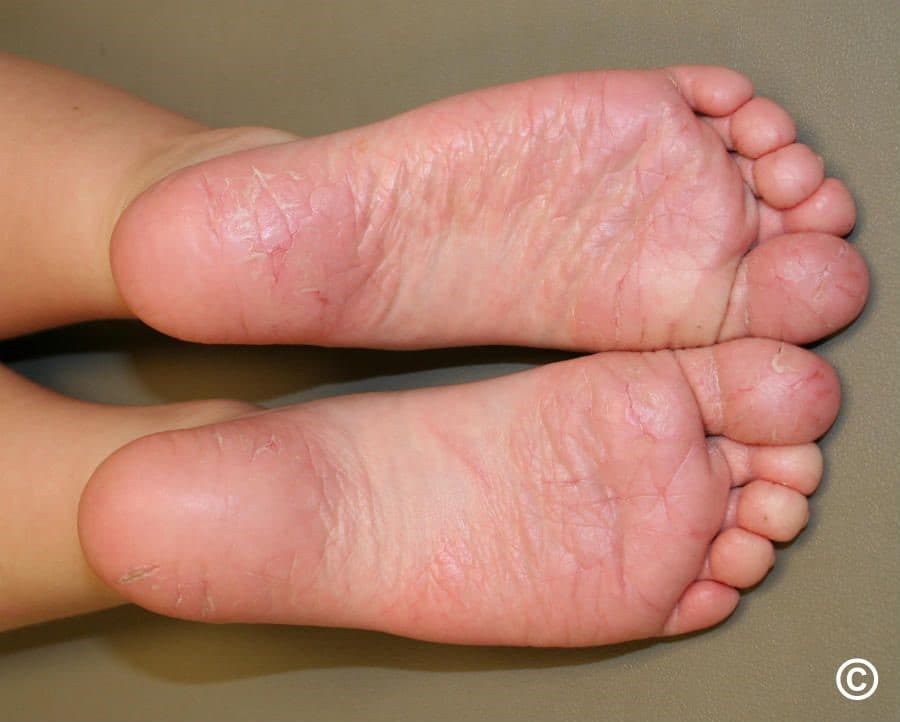
What juvenile plantar dermatosis is
Juvenile plantar dermatosis is a common, long-running dry-skin condition of the soles that mainly affects children before puberty (DermNet). The skin on the weight-bearing parts of the feet, first the ball of the big toe, then the rest of the forefoot and sometimes the heel, turns red, shiny and glazed, loses its fine ridge pattern, and then peels and cracks (DermNet, PCDS, JABFM review). Both feet are usually affected in the same pattern, and the skin between the toes (the toe webs) and the arch of the foot are usually spared (DermNet, PCDS, Canadian Family Physician).
Its other names include atopic winter feet, forefoot dermatitis, dermatitis plantaris sicca, moon-boot foot syndrome and sweaty sock dermatitis, the "sweaty sock syndrome" of everyday speech (DermNet).
It is not an infection and it is not caused by poor hygiene. The changes come from friction, sweat and repeated drying of the skin (DermNet, PCDS), and under the microscope there is inflammation around the sweat ducts rather than any germ (DermNet, Canadian Family Physician). It is also not athlete's foot, although the two are often confused; fungal infection of the feet is uncommon in children and juvenile plantar dermatosis is often misdiagnosed as one (JABFM review).
Who gets it
It affects children between 3 and 14 years, with an average age of 8 (DermNet). The PCDS puts the range at 3 to 15 and sees it most often in boys aged 4 to 8; overall it is slightly commoner in boys than girls (PCDS, DermNet) and rarely seen in adults (DermNet). In a patch-test clinic series of 389 children, 52 had a rash confined to the feet, and juvenile plantar dermatosis was the final diagnosis in 8 of them (15 %), behind allergic contact dermatitis (44 %) and atopic eczema (23 %) (Ortiz-Salvador 2017).
The link with atopy (eczema, asthma, hay fever) is less certain than often stated. The PCDS says a personal history of atopy is common and that affected children's skin is generally more sensitive, whereas DermNet notes that the suggested association with atopic eczema, asthma or hay fever has not been confirmed in case-control studies (PCDS, DermNet). In practice a child with atopic eczema may be more prone to it, but many affected children have no atopy at all.
Causes
There is no single cause. Several things act together on a child's sole (DermNet, PCDS, JABFM review):
- Friction: The foot moves up and down inside the shoe with every step, and the shearing force falls on the weight-bearing skin (DermNet, PCDS).
- Occlusive footwear: Closed shoes, especially synthetic ones (nylon or vinyl), trap heat and sweat (DermNet).
- Sweat followed by rapid drying: Sweat and a closed shoe soften and weaken the skin; the shearing across the weight-bearing surface then displaces the sweat ducts, so for a while no sweat reaches the surface and the skin dries out, becomes glazed and scaly and cracks (PCDS, DermNet). Over time the ridges of the sole flatten and the skin stops sweating properly there (JABFM review).
- A sensitive skin type: DermNet lists a genetic sensitivity of the skin, and atopic skin has a weaker barrier (DermNet, PCDS, MedlinePlus atopic dermatitis).
- Season: Flares come in summer from heat and sweating and in winter from boots, which is why DermNet finds no consistent seasonal pattern (DermNet, JABFM review); the PCDS sees frequent flares in warm weather (PCDS).
A shoe allergy is a separate cause of foot rash, but the two can coexist. In a series of 41 children with sole rashes, 29 % of those with juvenile plantar dermatosis had at least one relevant positive patch test; across the whole series the commonest culprits were rubber additives and the chromate used to tan leather, and the authors conclude that a diagnosis of juvenile plantar dermatosis should not put a doctor off patch testing (Darling 2012).
Symptoms
- Red, shiny, glazed skin on the weight-bearing areas: the ball of the big toe first, then the forefoot, the toe pads and sometimes the heel (DermNet, PCDS, JABFM review).
- Loss of the normal skin lines on the affected patches, which look tight and polished (DermNet).
- Peeling and scaling, followed by painful cracks (fissures) that can take many weeks or months to heal (DermNet, PCDS).
- Itch or soreness (DermNet), typically after a day in closed shoes.
- Symmetry: Both feet in the same places; the toe webs and the arch usually stay clear (DermNet, PCDS). The tops of the toes and the fingertips are rarely involved (PCDS, DermNet).
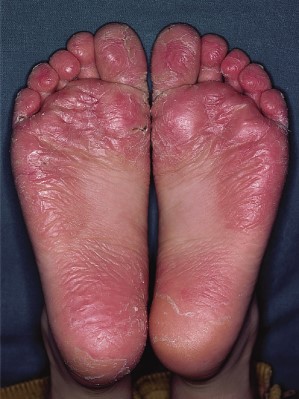
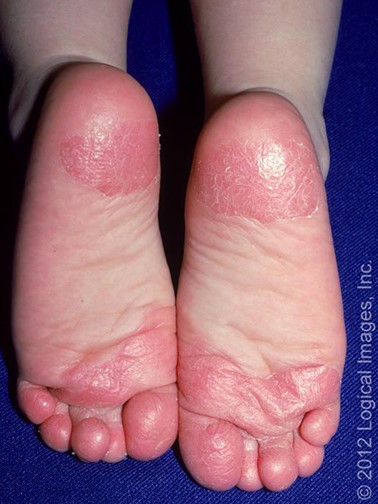
Both photographs show the typical picture: soles that are red, shiny and glazed, with peeling and cracks over the forefoot and toe pads, and in the first photo the heels as well, while the arches and the skin between the toes look normal. That distribution is the main feature that separates this condition from a fungal infection (DermNet, PCDS).
How it differs from athlete's foot and other foot rashes
| Condition | Where it sits | Clues | How it is confirmed |
|---|---|---|---|
| Juvenile plantar dermatosis | Weight-bearing soles, toe pads and big-toe ball, sometimes heels; both feet alike | Shiny, glazed red skin with cracks; toe webs and arch spared; age 3 to 14 (DermNet, PCDS) | Clinical; fungal scrapings negative (DermNet) |
| Athlete's foot (tinea pedis) | Between the toes, especially the fourth and fifth, sometimes the sole and sides; often one foot or asymmetrical | Itchy, white, soggy or flaky skin between the toes, sometimes blisters; can spread to the nails; uncommon in children (NHS athlete's foot, DermNet tinea pedis, JABFM review) | Skin scrapings for microscopy and culture (DermNet tinea pedis, NHS athlete's foot) |
| Shoe contact dermatitis | Tops of the feet and soles where the shoe touches; the toe creases and the top of the midfoot often spared; usually both feet | Itching, redness, blisters or cracks after a particular pair of shoes; caused by leather chromate, rubber chemicals, glues or dyes; the commonest diagnosis in a patch-test clinic series of children with foot-only dermatitis (DermNet shoe contact dermatitis, Ortiz-Salvador 2017) | Patch tests, including pieces of the shoe (DermNet shoe contact dermatitis) |
| Atopic eczema | Elbow and knee creases, hands, face; can include the feet | Itchy, dry, cracked skin elsewhere too; eczema, asthma or hay fever in the family (NHS atopic eczema) | Clinical (NHS atopic eczema) |
| Pompholyx (dyshidrotic eczema) | Sides of the fingers, palms and soles | Crops of tiny, deep, intensely itchy blisters that settle with peeling after 2 to 3 weeks; one-sided involvement points to a fungus instead (DermNet dyshidrotic eczema) | Clinical (DermNet dyshidrotic eczema) |
| Plantar psoriasis | Soles and palms, often with patches elsewhere | Thick, well-defined, silvery-scaled plaques, painful cracks, pitted nails; onset peaks at 15 to 25 and 50 to 60 years (DermNet psoriasis, NHS psoriasis) | Clinical (DermNet psoriasis) |
| Keratolysis exfoliativa | Palms more than soles; young active adults | Tiny air-filled blisters that burst into rings of peeling skin; often worse in summer; not usually itchy (DermNet keratolysis exfoliativa) | Clinical; scrapings and patch tests negative (DermNet keratolysis exfoliativa) |
| Pitted keratolysis | Pressure areas of the soles | Small pits in soggy, smelly skin of sweaty feet; a bacterial infection (DermNet pitted keratolysis) | Clinical (DermNet pitted keratolysis) |
Ruling out a fungal infection is the most important first step, because the anti-inflammatory creams used for dermatitis can make a fungal infection worse (JABFM review).
When to see a doctor
Book a routine appointment if the soles are no better after a few weeks of the footwear, sock and moisturiser changes described below, if the cracks are painful, bleed or stop your child walking or playing, if you cannot tell whether this is a fungus, an allergy or psoriasis, or if the rash keeps coming back.
Get a same-day appointment (your GP or local urgent-care service; NHS 111 in the UK, and in Ireland the nearest hospital if you cannot reach a GP) if the feet show signs of infection: spreading redness, heat and swelling, pus or yellow crusts, a crack that is suddenly far more painful, or a child who is feverish or unwell (NHS atopic eczema, NHS athlete's foot, HSE eczema). Clusters of small, painful fluid-filled blisters together with fever can be eczema herpeticum, a viral infection that needs urgent treatment (HSE eczema, DermNet eczema herpeticum). Golden crusts spreading over the skin point to impetigo, which is contagious and is treated by a pharmacist or GP (NHS impetigo). A child with diabetes or a weakened immune system should see a doctor about any foot rash or infection rather than relying on pharmacy treatment (NHS athlete's foot).
Secondary bacterial infection is rare in juvenile plantar dermatosis itself (DermNet), but deep cracks let bacteria in (JABFM review), so the warning signs matter.
Diagnosis
The diagnosis is made from the appearance and the story: the child's age, the pattern on both soles with clear toe webs, the type of shoes and socks, sweating and any eczema (DermNet, PCDS). Tests are used to rule other things out rather than to confirm it (DermNet):
- Skin scrapings for fungal microscopy and culture if athlete's foot is possible, which matters most when the toe webs or nails are involved (DermNet, DermNet tinea pedis).
- Patch tests for a footwear allergy; in children with sole rashes they give a relevant positive result often enough that an atopic history or a diagnosis of juvenile plantar dermatosis should not put a doctor off testing (Darling 2012, DermNet).
- A skin biopsy is rarely needed; when done it shows spongy inflammation of the epidermis and inflammation around the sweat ducts (DermNet).
What an online consultation can do: Sharp photographs of both soles, the spaces between the toes and the tops of the feet, together with a description of the shoes, socks, sweating and any eczema, can often let an iDerma dermatologist recognise the pattern, tell it apart from athlete's foot or a shoe allergy, and set out a care plan. Scrapings, patch tests and a swab of an infected crack are done in person, and the dermatologist will say so if they are needed.
Treatment
There is no treatment that reliably clears this condition. DermNet states that there is no consistently useful treatment and that the usual recommendations are general measures without supporting studies to show benefit (DermNet). The condition is self-limiting (PCDS, DermNet). The aim of treatment is therefore fewer cracks, less pain and comfortable feet until it clears on its own.
Footwear and socks
- Well-fitting shoes, preferably leather, to cut friction; avoid shoes and socks made of synthetic materials (DermNet, PCDS).
- Replace synthetic insoles with natural ones such as cork (PCDS).
- Cotton socks (or wool, if your child's skin tolerates it), changed as soon as they are damp (DermNet, PCDS); two pairs worn together are thought to reduce friction (DermNet, DermNet shoe contact dermatitis). Change sweaty socks after sport (JABFM review).
- Alternate between two pairs of shoes so that each dries fully, and avoid enclosed boots and sports shoes that make feet sweat more (NHS excessive sweating, NHS athlete's foot).
- Shoes off indoors and barefoot time wherever it is safe; sandals in warm weather (PCDS, Canadian Family Physician).
Moisturise and protect the skin
- After the bath and before bed, apply a moisturising cream containing urea or a plain greasy ointment such as petroleum jelly; a greasy emollient applied under socks can greatly improve symptoms (DermNet, PCDS, JABFM review). Urea-containing creams can sting on cracked skin, so use the greasy ointment on open fissures and the urea cream on intact dry skin (DermNet emollients).
- During the day, use a silicone-based barrier cream, reapplied about every 4 hours (DermNet, Canadian Family Physician).
- Smooth emollients on gently rather than rubbing them in; pat the feet dry after washing, then apply straight away while the skin is still slightly damp (NHS emollients, HSE emollients, MedlinePlus atopic dermatitis).
- Do not use aqueous cream as a leave-on moisturiser, because it can irritate the skin, especially in children with atopic eczema (NHS atopic eczema, HSE emollients). Keep paraffin-based emollients away from flames: fabrics that have soaked them up catch fire easily (HSE emollients, NHS atopic eczema).
Rest and cover the cracks
- Build in a quiet period each day with little walking so that fissures can heal (DermNet), and skip strenuous exercise for a few days while cracks are deep (PCDS).
- Cracks heal faster when covered, and an adhesive plaster is the simplest option (DermNet, PCDS). DermNet describes sealing a painful fissure with a liquid skin glue for pain relief, and the PCDS says a parent may apply clear nail varnish or a commercial glue with great care (DermNet, PCDS); we suggest asking your doctor to show you before trying it.
Prescription treatments
If the skin is red and itchy, a doctor may prescribe a short course of a mild to moderately potent anti-inflammatory steroid cream, applied thinly for a few days until the inflammation settles (PCDS, JABFM review). For stubborn fissures there are medicated tapes and plasters that are left on for up to 24 hours at a time (PCDS). A steroid-free anti-inflammatory ointment is an alternative for courses of up to 4 weeks (DermNet). The creams and ointments rarely prove more effective than simple emollients, which is why footwear, socks and greasy moisturiser remain the core of treatment (DermNet, PCDS). If a crack becomes infected, a pharmacist or doctor may prescribe an antiseptic or antibiotic treatment, as for impetigo, and will advise on how to care for the area (NHS impetigo).
Sweaty feet
If sweating is clearly driving flares, try moisture-absorbing socks changed at least twice a day, leather shoes rotated day to day and foot powders from the pharmacy (NHS excessive sweating); a foot antiperspirant also reduces reactions (DermNet shoe contact dermatitis), and for a child we suggest checking with the pharmacist or doctor first.
Care and prevention of flare-ups
- Shoes: leather uppers, breathable, properly sized, with a natural-fibre insole; two pairs in rotation (DermNet, PCDS, NHS excessive sweating).
- Socks: cotton (or wool if tolerated), clean every day and changed when damp; doubled for sport (DermNet, PCDS).
- Moisture: shoes off as soon as the activity ends; dry the feet, including between the toes, by patting (NHS athlete's foot, HSE athlete's foot).
- Washing: wash with an emollient instead of soap, and moisturise straight afterwards (NHS atopic eczema, NHS emollients).
- Emollient routine: urea cream or greasy ointment every evening, barrier cream by day, even when the soles look better (DermNet, PCDS).
- Changing rooms and pools: flip-flops or sliders on wet floors, so that cracked soles do not pick up athlete's foot as well (NHS athlete's foot, HSE athlete's foot).
School, sport and swimming
There is nothing to catch: this is a friction and sweat dermatitis, not an infection (DermNet, PCDS), so school, nursery, football and swimming can continue. Most situations are covered by two pairs of socks under sports shoes, a change of socks at half-time, drying and moisturising the feet afterwards, and a few quiet days when a crack is deep (DermNet, PCDS). Children with impetigo stay off school or nursery until 48 hours after treatment has started (NHS impetigo); ask the doctor about any other infected crack.
Juvenile plantar dermatosis in adults
The condition is rarely seen in adults, although it can persist from childhood into adult life (DermNet). An adult with red, cracked, peeling soles should be assumed to have one of the other plantar dermatoses until shown otherwise: athlete's foot, pompholyx, contact dermatitis, psoriasis, an irritant dermatitis or a keratoderma (DermNet, DermNet tinea pedis). Those need scrapings or patch tests, so an adult should get the cause confirmed rather than adopt the children's advice above. Thickened pressure skin without redness is more likely to be calluses and corns.
Outlook
Juvenile plantar dermatosis usually clears by itself in adolescence, most often between 12 and 16 years, after a course of around 2 to 4 years with flares and quieter spells in between (PCDS, DermNet). A minority carry it into adult life (DermNet). There is no evidence that footwear and emollient care shorten the course, but they are the measures available to ease the pain and cracking in the meantime (DermNet).
What to do now
- Look at both soles and between the toes. Shiny red peeling on the balls of the feet with clear toe webs fits juvenile plantar dermatosis; soggy, itchy skin between the toes points to athlete's foot instead.
- Start today: leather or open shoes, cotton socks doubled and changed when damp, a greasy ointment under socks at night, plasters on any crack.
- If the soles are not clearly better in a few weeks, or you are unsure of the diagnosis, book an online consultation with photographs of both soles, the toe webs and the tops of the feet, or use our online dermatitis consultation page to see how it works.
- Heat, swelling, pus, crusts or fever mean a same-day in-person appointment, not an online one.