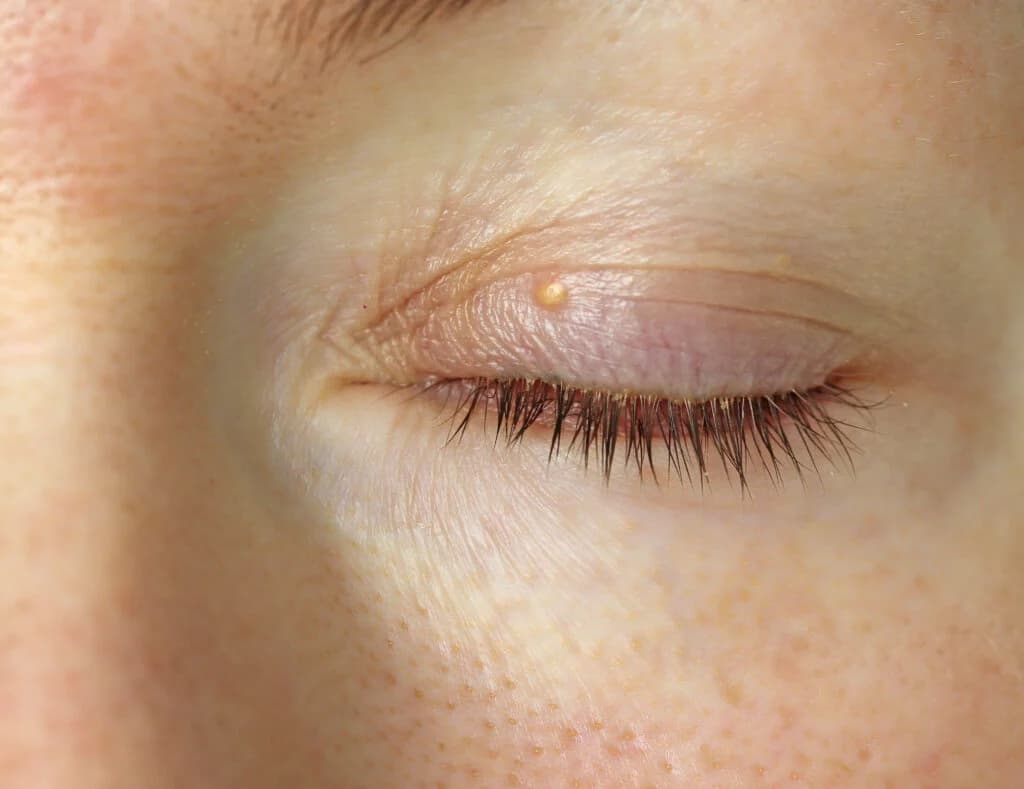
What is xanthelasma?
Xanthelasma (xanthelasma palpebrarum) is a soft, flat or slightly raised yellow plaque on the eyelid. It is made of immune cells in the skin (macrophages) that have filled up with fat, mostly cholesterol, and it is the most common form of a group of fatty skin deposits called xanthomas (DermNet, Christoffersen 2011). The usual spot is the inner corner of the upper eyelid, often on both sides at once (DermNet, AAO).
Xanthelasma is not a cancer and cannot be caught from anyone. It does not go away on its own: once it has formed it tends to stay the same size or grow slowly (AAO). It matters for two reasons: it sits in the middle of the face, and it can be the first visible sign that blood fats are raised or that the risk of heart disease is higher than it looks (AAO, Christoffersen 2011).
How common it is depends on the population studied. A review puts the prevalence at about 1.1% of women and 0.3% of men (Nair 2017); in the Copenhagen City Heart Study, which examined 12,745 adults, 4.4% had xanthelasma at the start (Christoffersen 2011).
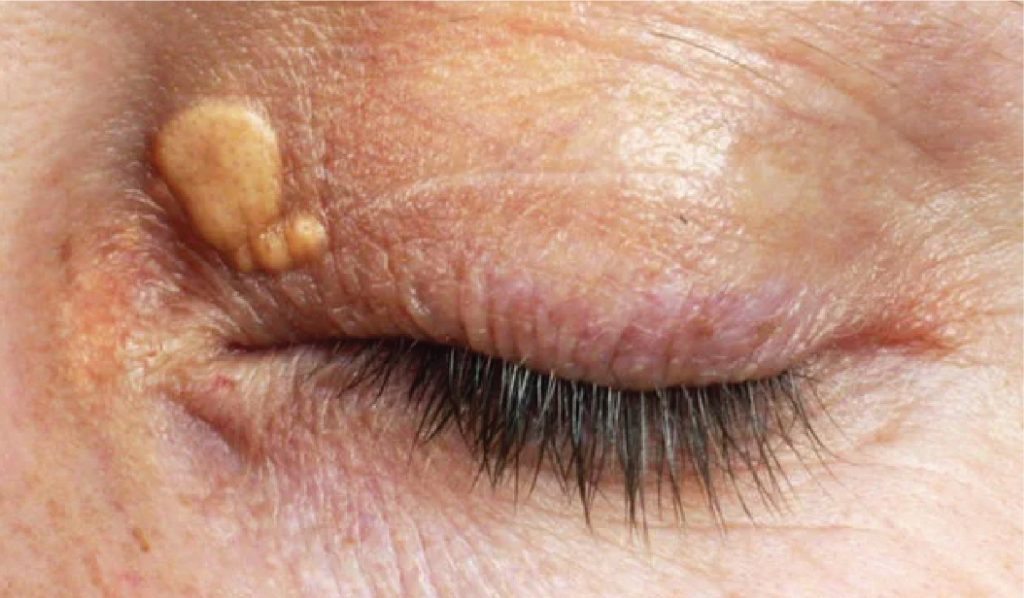
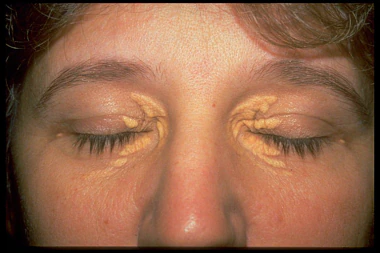
Xanthelasma: a single soft yellow plaque at the inner corner of an upper eyelid, and plaques on all four eyelids in a more extensive case.
Who gets xanthelasma?
It is a condition of adults. It starts as a small bump that enlarges slowly over several months (DermNet). Women are affected more often than men (AAO, Nair 2017), and it is more common in people of Asian or Mediterranean descent (AAO).
Roughly half of the people who develop xanthelasma have raised cholesterol. The other half have normal blood fats, which is why other factors, including local inflammation, are thought to play a part (AAO). You are more likely to get it if you smoke, are overweight, have high blood fats, high blood pressure or diabetes (AAO).
Xanthelasma is also one of the visible signs of familial hypercholesterolaemia, an inherited form of very high cholesterol that affects about 1 in 250 people. Each child of an affected parent has a 1 in 2 chance of inheriting it, and most people who have it do not know (BHF). Xanthelasma appearing in a younger adult, or together with lumps over the knuckles or the Achilles tendon, is a reason to ask about it (BHF).
What causes xanthelasma?
Fat accumulates inside macrophages in the skin and the plaque is the visible result (DermNet). Why it settles on the eyelids in particular is not fully understood. The conditions that are linked with it are disorders of fat metabolism (dyslipidaemias), which may be primary or secondary (DermNet):
- Inherited high cholesterol, in particular familial hypercholesterolaemia (DermNet, BHF).
- Secondary causes of raised blood fats: obesity, type 2 diabetes and insulin resistance, an underactive thyroid, liver disease that blocks the flow of bile (such as primary biliary cholangitis), kidney disease with heavy protein loss, and some medicines, including certain hormone treatments (DermNet, MedlinePlus).
- No cause found. Xanthelasma often occurs with normal blood fats (DermNet, MedlinePlus). A cholesterol test is still worthwhile: about half of the people with xanthelasma do have raised blood fats (AAO), and the heart-risk assessment your doctor makes needs the value (NHS cholesterol levels).
Fatty deposits elsewhere on the body are, unlike xanthelasma, almost always a sign of a lipid disorder (DermNet): firm nodules over the Achilles tendon or knuckles (tendon xanthomas), red-yellow lumps over the knees and elbows, a yellow tint in the creases of the palms, or sudden crops of small yellow papules with a red rim on the buttocks and shoulders (DermNet). Mention any of these to your doctor.
Symptoms: what xanthelasma looks like
- Colour and texture. Soft, velvety, yellow to yellow-orange, with a sharp edge. The plaques may be completely flat or slightly raised (DermNet, Christoffersen 2011).
- Location. Most often at the inner corner of the upper eyelid; the lower lids can be affected too. Plaques often appear on both sides symmetrically (DermNet, Nair 2017).
- Number and size. One or several, from a couple of millimetres to plaques that run along most of the lid. Neighbouring plaques can merge (DermNet).
- Sensation. Xanthelasma is painless (MedlinePlus) and does not harm the eye itself (AAO). Any eyelid lump that is red, hot or painful is something else and needs a same-day assessment (NHS eyelid problems).
- Course. Slow growth over months, then usually a plateau. Plaques do not disappear by themselves (DermNet, AAO).
Is xanthelasma dangerous?
The plaque itself is harmless (AAO, MedlinePlus). The question is what it says about the rest of you.
In the Copenhagen City Heart Study, the same 12,745 adults were followed for up to 33 years. People who had xanthelasma at the start were more likely to have a heart attack, to develop ischaemic heart disease and severe atherosclerosis, and to die earlier, and this held after adjusting for cholesterol, triglycerides and the other known risk factors. In other words, the extra risk was not explained by cholesterol levels alone. Arcus corneae, the grey-white ring at the edge of the cornea, did not carry the same independent risk (Christoffersen 2011). DermNet summarises the same finding: xanthelasma appears to be an independent predictor of ischaemic heart disease (DermNet).
The practical conclusion is to have your cardiovascular risk assessed properly rather than treat the plaque as a purely cosmetic problem. High cholesterol has no symptoms of its own; a blood test is the only way to find out (NHS, HSE). In the UK the NHS suggests asking your GP or family doctor for a test if you are over 40, overweight, or if high cholesterol or heart problems run in your family (NHS getting tested). Your doctor will put the result together with your age, blood pressure and other conditions to estimate your 10-year risk of a heart attack or stroke (NHS cholesterol levels).
| Result | Healthy level for adults (NHS guide) |
|---|---|
| Total cholesterol | Below 5 mmol/L |
| HDL ("good" cholesterol) | Above 1.0 mmol/L for men, above 1.2 mmol/L for women |
| Non-HDL ("bad" cholesterol) | Below 4 mmol/L |
These are the NHS guide figures for healthy adults; your own target depends on your overall risk (NHS cholesterol levels).
Xanthelasma or something else?
Several harmless bumps occur on the eyelids, and so do a few that are not harmless. The yellow colour and the flat, soft, sharply edged plaque at the inner corner of the lid are the clues to xanthelasma. The table lists the usual look-alikes.
| Condition | How it differs from xanthelasma |
|---|---|
| Syringoma | Firm, rounded 1 to 3 mm papules, skin-coloured, white or yellowish, in clusters on the lower eyelids and cheeks; often many of them (DermNet syringoma). |
| Milia | Tiny 1 to 2 mm pearly-white keratin cysts on the eyelids and cheeks; firm, not yellow; they may clear within weeks or persist for months (DermNet milium). |
| Sebaceous hyperplasia | Small yellow bumps up to 3 mm with a central dip, on the forehead and cheeks of middle-aged and older people rather than on the lid itself (DermNet sebaceous hyperplasia). |
| Chalazion (meibomian cyst) or stye | A rounded lump within the lid that appears over days, may be tender or red, and usually settles by itself over weeks (NHS eyelid problems). |
| Hidrocystoma | A translucent, jelly-like cyst on the eyelid rather than a yellow plaque (DermNet cysts). |
| Seborrhoeic keratosis | A brown or skin-coloured warty spot with a "stuck-on" look, not yellow and not soft (DermNet seborrhoeic keratosis). |
| Basal cell carcinoma | A shiny or pearly nodule that keeps growing, may ulcerate or bleed and does not heal. Any eyelid lump that behaves like this must be examined (DermNet basal cell carcinoma). |
When to see a doctor
See a GP if you have yellow lumps or patches around your eyes (NHS eyelid problems). There are two reasons: to confirm that the plaque is xanthelasma, and to have your cholesterol and heart risk checked. See a doctor sooner, and do not wait for a routine slot, if:
- the lump is growing quickly, bleeds, crusts or ulcerates, which is not how xanthelasma behaves (DermNet basal cell carcinoma);
- the eyelid is red, hot, painful, tender or blistered, your eyelid droops suddenly, you cannot open the eye, your vision changes or you have a high temperature. These need an urgent appointment the same day (NHS eyelid problems).
Because the diagnosis is made by appearance (DermNet, MedlinePlus), a dermatologist can usually recognise xanthelasma from clear, well-lit photographs. At iDerma we assess eyelid lesions online and can usually confirm the diagnosis. We also tell you which blood tests to ask your GP for, and which removal methods are likely to suit the size and depth of your plaques; you can book an online consultation and upload your photos. Removal itself is done in person by a dermatologist or an oculoplastic surgeon near you.
How xanthelasma is diagnosed
The diagnosis is made by looking: the appearance is characteristic, and a skin biopsy is only needed when the plaque is unusual (DermNet, AAO, MedlinePlus). Under the microscope the dermis contains the typical lipid-filled macrophages (DermNet).
Most of the assessment is the search for an underlying cause. The usual investigations (DermNet):
- a lipid profile: total cholesterol, HDL, non-HDL or LDL, and triglycerides (NHS cholesterol levels);
- liver, thyroid and kidney function tests;
- fasting blood glucose, or another test for diabetes (MedlinePlus).
The cholesterol test is a blood sample from the arm; fasting beforehand is not always needed. Some pharmacies offer a finger-prick version, as does the NHS Health Check for people over 40 in England (NHS getting tested). If a result is high, the next step is a conversation about diet, exercise and, for some people, medicines, based on your estimated 10-year cardiovascular risk (NHS getting tested, HSE treatment).
Treatment of xanthelasma
Treatment has two separate parts: looking after the cause, and removing the plaque. Lowering raised blood fats protects the heart but rarely clears the plaque, and removal clears the plaque without changing the risk (AAO, DermNet).
1. Treat the underlying condition
If your blood fats are raised, the first step is to lower them. The NHS advice is to eat less saturated fat (fatty meat, butter, cream, cakes, coconut and palm oil) and more oily fish, olive or rapeseed oil, wholegrains, nuts, fruit and vegetables; to do at least 150 minutes of moderate exercise a week; to stop smoking; and to keep alcohol under 14 units a week (NHS how to lower). If this is not enough, or your overall risk is high, your GP will discuss cholesterol-lowering medicines, which are taken long term (HSE treatment). Xanthelasma may improve when an associated high cholesterol is successfully treated, but it usually does not disappear (DermNet, AAO), so most people who want it gone also need the plaque removed.
2. Remove the plaque
Removal is done for cosmetic reasons and the method depends on how large, how many and how deep the plaques are (DermNet, Nair 2017). The options a dermatologist will discuss (DermNet, AAO):
- Chemical cauterisation. A medical-grade acid is applied precisely to the plaque, which crusts and peels off over the following days. Suited to thin, flat plaques (DermNet, Nair 2017).
- Electrosurgery. A fine electrode destroys the superficial plaque with heat; xanthelasma is one of its standard uses (DermNet electrosurgery).
- Cryotherapy. Freezing the plaque. Blistering and temporary swelling around the eye are common afterwards, and lighter patches of skin or a scar can remain (DermNet cryotherapy).
- Laser treatment. Ablative lasers vaporise the plaque with little bleeding and little surrounding damage. Best for small, shallow plaques; deep plaques treated with a laser can leave a defect in the lid (DermNet, Nair 2017).
- Surgical excision. The plaque is cut out under local anaesthetic. The Nair review lists excision as the usual choice when there is a known inherited lipid disorder, when all four eyelids are involved or when the plaque has recurred more than once, and prefers it for deep plaques, where surface methods risk a defect in the lid (Nair 2017).
All methods can leave a scar or a change in skin colour, and xanthelasma can return whichever method is used (AAO, Nair 2017). In one surgical series it came back in about 40% of people after a first excision, 60% after a second, and 80% when all four lids were involved; recurrence was more likely in people with a lipid disorder (Nair 2017). Keeping cholesterol under control is part of keeping the eyelids clear (AAO).
Can you remove xanthelasma at home?
No. Every effective method works by destroying the plaque with acid, heat, cold or a blade, and on an eyelid that is done with magnification, millimetres from the eye, by someone who can judge the depth (AAO, Nair 2017). The fat deposits sit in the dermis, below the surface (DermNet), where over-the-counter "xanthelasma creams", acids bought online, garlic and other home remedies do not reach; what an acid or a burn does reach is the thin eyelid skin, and scarring and colour change are the recognised complications even of professional treatment (AAO). If you want it removed, see a dermatologist (AAO).
Care and prevention
No measure is known to prevent a first plaque in someone with normal blood fats. What you can influence is the risk of new plaques and, above all, the risk to your heart (AAO):
- Have your cholesterol checked, and rechecked as your doctor advises (NHS getting tested).
- Follow the diet, exercise, smoking and alcohol advice above (NHS how to lower).
- Keep diabetes, thyroid and liver conditions under treatment (DermNet, MedlinePlus).
- If you have had plaques removed, have any new spot looked at early; small plaques are easier to treat than large ones (Nair 2017).
Outlook
Xanthelasma stays benign. The outlook depends on the condition behind it, which is why the cholesterol test matters more than the plaque (DermNet). Removal gives a good cosmetic result in most people, with the recurrence figures above (AAO, Nair 2017).
What to do now
- Take two clear photographs of each eye in daylight, with the eye closed and open.
- Ask your GP for a cholesterol test (lipid profile) and, if you have not had them recently, blood glucose and thyroid tests; mention any family history of early heart disease or very high cholesterol (NHS getting tested, BHF).
- Book an online consultation with an iDerma dermatologist to confirm the diagnosis and to discuss which removal method suits your plaques.
- Do not apply acids, creams or heat to the plaque yourself (AAO).