What is lichen planus?
Lichen planus is an inflammatory condition in which the body's own immune cells attack the skin and the moist linings of the mouth and genitals (DermNet, BAD). On the skin it produces clusters of small, shiny, flat-topped bumps with a purple tinge; in the mouth, white lacy patterns; it can also thin the nails and, on the scalp, cause patches of permanent hair loss (DermNet, NHS). About 1 in 100 people develop it, most between 30 and 60 (DermNet). It is not an infection: you cannot catch it and cannot pass it on (NHS).
The medical name is descriptive: "lichen" refers to small bumps and "planus" means flat, hence the flat-topped papules (PCDS). It is not the same as lichen simplex chronicus, the thickened, leathery patch that months of scratching produce, which has its own page and is compared below.
Who gets it and why
Lichen planus is an immune-mediated disorder in which T lymphocytes attack an unknown protein in the lowest layer of the skin (DermNet). Why that starts is not understood (BAD). Factors that can set it off or make it more likely (DermNet, BAD):
- Genetic predisposition. It is not inherited, but the tendency occasionally runs in families (BAD).
- Physical and emotional stress (DermNet, BAD).
- Injury to the skin. New bumps often appear along a scratch, a surgical scar or other skin damage, the Koebner phenomenon (DermNet, BAD).
- Infections: hepatitis C and hepatitis B, herpes viruses, and a previous local episode of shingles (DermNet, BAD).
- Contact allergy, most relevant in the mouth, where metal dental fillings can cause a lichen-planus-like reaction on the adjacent gum or cheek; this is rare (DermNet, PCDS).
- Medicines. Some tablets for blood pressure, malaria, infections and depression can produce a lichenoid drug eruption that imitates lichen planus (BAD, DermNet); the gap between starting the medicine and the rash is usually two to three months but can be more than a year (DermNet).
The oral form is more common in women (DermNet). Lichen planus is rare in children (BAD). Vitamin D deficiency has been linked to oral lichen planus, but not, so far, to the other forms (DermNet).
What it looks like on the skin
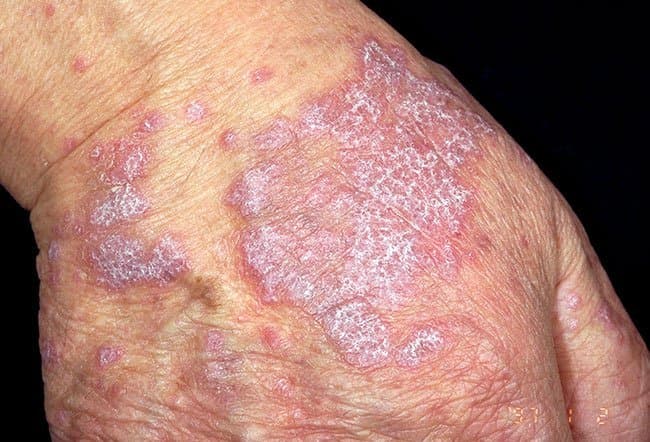
Dermatologists often summarise the classic rash with six words beginning with P: planar (flat-topped), polygonal (angular outline), purple, pruritic (itchy), papules (small bumps) and plaques (bumps that have merged); (DermNet, PCDS). What that means on the skin:
- Clusters of shiny, firm, flat-topped bumps 1 to 3 mm across, sometimes merging into larger plaques up to a centimetre or more (DermNet, BAD).
- A purple or violet colour when new; on the palms and soles yellowish-brown (DermNet). In black or brown skin the purple may be hard to see: the bumps look darker than the surrounding skin, sometimes with a purplish hue (NHS, BAD).
- Fine white lines across the surface, called Wickham striae, best seen with a magnifier; in darker skin the lines may be white or simply paler than the background (DermNet, PCDS, BAD).
- Itch ranging from none, which is uncommon, to intense (DermNet, BAD, NHS).
- Favourite sites: the front of the wrists, the ankles and the lower back, but anywhere is possible; the rash may be scattered, grouped, in a line along a scratch, or ring-shaped (DermNet, PCDS).
- Over months the bumps flatten and leave greyish-brown marks that can take a year or longer to fade, especially in darker skin (DermNet, PCDS).
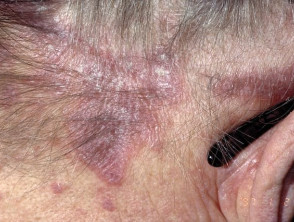
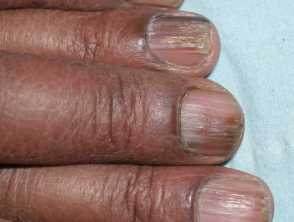
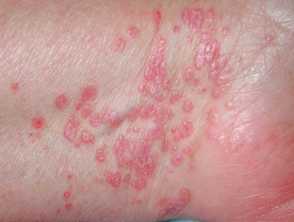
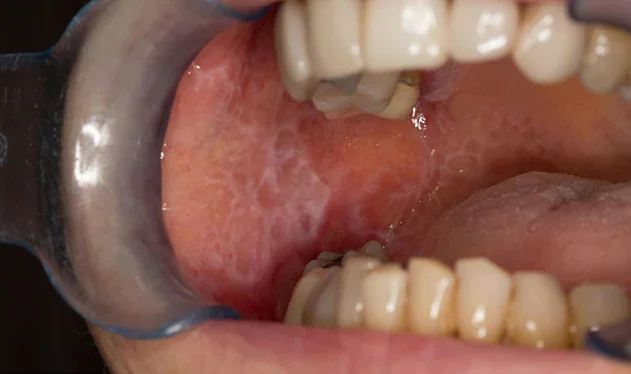
The photographs above are from the iDerma image library: violet plaques on the skin beside the ear and temple, lengthwise ridging and thinning of the fingernails in brown skin, a cluster of pink-purple flat-topped bumps on the inner wrist, and the white lacy pattern of oral lichen planus on the inside of a cheek.
Types of lichen planus
Lichen planus takes several patterns, and a person may have one type or several at once (DermNet, BAD).
- Classic cutaneous lichen planus: the itchy purple bumps described above (DermNet).
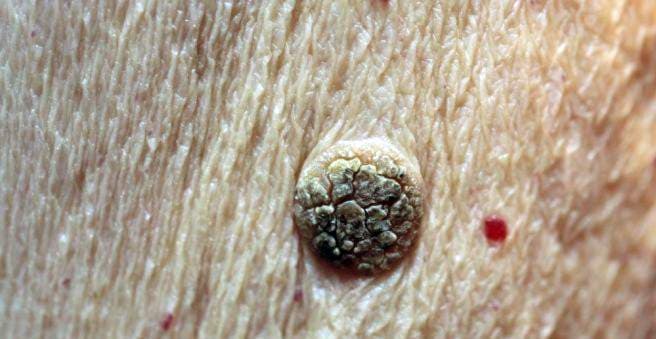
- Hypertrophic lichen planus: thick, scaly, very itchy plaques, usually on the shins and ankles, that can look like warts and can persist for years; a biopsy is sometimes needed to tell it from a skin cancer (BAD, PCDS, DermNet).
- Annular lichen planus: ring-shaped lesions with an active rim and a slightly sunken centre, often on the penis, in the armpits or groin, or on the palms and soles (DermNet, BAD, PCDS).
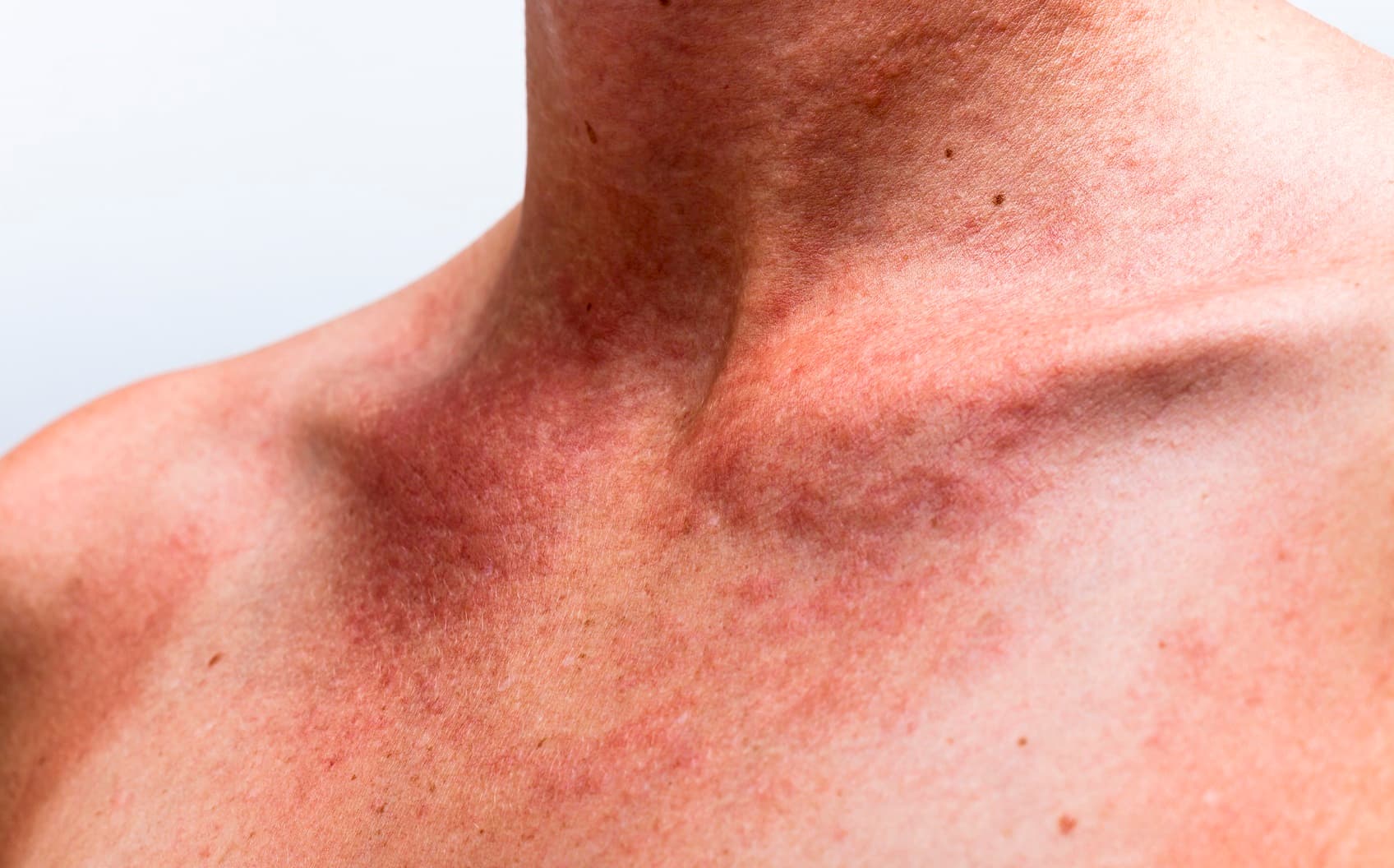
- Actinic lichen planus: red-brown rings or dark patches on sun-exposed skin, mainly in young adults of Middle Eastern, East African or Indian descent; worse in summer, not itchy, no Koebner response (DermNet, BAD).
- Lichen planus pigmentosus: ill-defined oval greyish-brown marks on the face, neck or trunk without a preceding bumpy rash and usually without itch; more common in darker skin, and the course is often very prolonged (DermNet, BAD, PCDS).
- Bullous lichen planus: rare; blisters form within the rash, usually on the lower legs (DermNet, BAD).
- Lichenoid drug eruption: a medicine-induced imitation, more often on the trunk, more scaly and often less itchy; it fades slowly once the medicine is withdrawn (DermNet, PCDS).
- Oral, genital, nail and scalp lichen planus, described next, which can each occur with or without the skin rash (DermNet).
Mouth, genitals, nails and scalp
Mouth
The mouth is often involved: about half of people with the skin rash have oral lichen planus, and in about 15% of all cases the mouth is the only site (PCDS, DermNet). The usual pattern is white streaks in a lacy or fern-like network on the inside of the cheeks or the sides of the tongue, sometimes on the gums and lips (DermNet). Other forms are red, shiny, peeling gums (desquamative gingivitis) and painful, persistent erosions or ulcers that make eating, drinking and brushing uncomfortable; spicy food, citrus and alcohol sting (DermNet, BAD). Oral lichen planus tends to last longer than the skin rash, often for years (BAD, DermNet).
Genitals
On the vulva lichen planus can appear as lacy white streaks, as raw red eroded areas at the entrance to the vagina, or as a painful inflammation inside the vagina that bleeds easily and makes intercourse impossible; scarring can shrink the inner lips and narrow the entrance (DermNet). On the penis it most often forms a ring of papules around the head; erosions are less common (DermNet, PCDS). Erosive genital lichen planus is a destructive form that needs specialist care, often shared with a gynaecologist (DermNet, BAD).
Nails
About one in ten people with lichen planus have nail changes, fingernails more than toenails: thinning of the nail plate, lengthwise ridges and grooves, roughness, darkening or lifting from the nail bed; occasionally the cuticle scars onto the nail (a pterygium) or a nail is lost (DermNet, PCDS). Nail disease can progress quickly and the damage can be permanent, so early referral matters (PCDS, BAD).
Scalp and hair
On the scalp lichen planus attacks the hair follicles. The form called lichen planopilaris shows as tiny red, scaly, spiny bumps around the hairs and smooth patches without follicle openings; the hairs come out easily, and the hair loss is permanent (DermNet). Frontal fibrosing alopecia is a variant that pushes the hairline back across the forehead and thins the eyebrows, mostly in women after the menopause (DermNet). Itching, redness and scaling of the scalp with thinning hair are a reason to be seen quickly: treatment aims to stop further scarring hair loss, and hair lost to scarring does not regrow (DermNet, BAD).
Is it dangerous?
For most people lichen planus is not serious: in most people it heals by itself (BAD), and the skin rash clears on its own in time (NHS). Three complications matter (DermNet, BAD, PCDS):
- Permanent damage where the disease scars: bald patches on the scalp, deformed nails, and adhesions or narrowing in the vagina.
- A small risk of squamous cell carcinoma in long-standing erosive lichen planus of the mouth, vulva or penis, and rarely in hypertrophic lichen planus. For the mouth the figure quoted is about 1% over ten years (BAD). An enlarging lump or an ulcer with thickened edges that does not heal should be seen promptly, and people with oral lichen planus are advised to have an annual dental review (DermNet, PCDS).
- Trouble swallowing when the oesophagus is involved, which is uncommon (DermNet).
Conditions that look similar
Several rashes share the colour, the shape or the itch (DermNet, NHS). What points away from lichen planus:
| Condition | How it differs from lichen planus |
|---|---|
| Lichen simplex chronicus | One or a few large plaques of thickened, leathery skin with exaggerated skin lines, produced by months of scratching; the mouth and nails are not described as sites (DermNet) |
| Psoriasis | Red plaques with thick silvery scale on the elbows, knees and scalp; lichen planus is not usually scaly (DermNet, PCDS, NHS) |
| Pityriasis rosea | Oval pink scaly patches on the chest and back following a single larger "herald patch", clearing in 6 to 10 weeks (DermNet, NHS) |
| Lichen nitidus | Pinhead-sized skin-coloured shiny bumps, mostly in children; once regarded as a variant of lichen planus, now a separate condition (DermNet) |
| Granuloma annulare | Smooth skin-coloured or red rings over the knuckles and other joints, usually not itchy; listed as the differential of ring-shaped lichen planus (DermNet, PCDS) |
| Ringworm (tinea) | A fungal infection that forms ring-shaped patches (DermNet, NHS) |
| Eczema (atopic dermatitis) | Dry, cracked, sore, red and itchy skin (NHS), typically in the elbow and knee creases, and thickened where it has been rubbed for a long time (DermNet) |
| Viral warts | Hypertrophic lichen planus on the shins can look like warts; a biopsy settles it (BAD) |
| Lichen sclerosus | White, crinkled, thinned genital skin that itches and scars; it can coexist with genital lichen planus (DermNet, NHS) |
| Lichenoid drug eruption | The same rash caused by a medicine, usually on the trunk; the clue is a new tablet started months earlier (DermNet) |
How it is diagnosed
Most cases are recognised on examination from the shape, colour and distribution of the bumps and the white lines (DermNet, PCDS). A dermatoscope, the hand-held magnifier dermatologists use, shows the Wickham striae clearly and has made the diagnosis in rashes that did not look typical to the naked eye (PCDS). Investigations are not normally needed in typical cases (PCDS); a skin biopsy is often recommended to confirm the diagnosis and is considered when the rash is atypical, hypertrophic or long-standing, to look for cancer (DermNet, BAD). Patch testing is suggested for oral lichen planus on the gums next to metal fillings (DermNet). Blood tests are not routine (PCDS); hepatitis C is listed among the contributing factors, and your dermatologist decides whether to test for it (DermNet).
In iDerma's experience, classic skin lichen planus can often be recognised from sharp daylight photographs, taken from a distance to show the distribution and close up to show the surface of the bumps, so an online consultation is a reasonable first step. Mouth, genital, nail and scalp involvement more often needs an in-person examination, and the dermatologist will say when a biopsy is needed.
Treatment
No medicine was developed specifically for lichen planus, and mild lichen planus without symptoms often needs no treatment at all (BAD, DermNet). Treatment aims to control itch and pain, limit spread and prevent permanent damage to hair, nails and mucous membranes (BAD). The specific prescription depends on the site and severity; a plan is usually built from these classes.
- Skin care first: avoid soaps and shower gels and use an emollient regularly (DermNet, NHS). A sedating antihistamine tablet at night can help troublesome night-time itch (DermNet).
- A potent or very potent steroid cream or ointment applied carefully once a day to the active bumps until the rash flattens and the itch settles (BAD, PCDS). Once the bumps have turned into flat grey-brown marks the steroid should stop: those marks are no longer active and will fade on their own (BAD, PCDS). Steroid-impregnated tape is an option for thick plaques (DermNet).
- Steroid-free anti-inflammatory creams, a prescription class, for delicate sites such as the face, armpits and groin, where long-term steroid use would thin the skin (BAD, DermNet).
- Steroid injections into thick hypertrophic plaques or individual affected nails (DermNet, BAD).
- For severe or widespread disease: a one- to three-month course of steroid tablets while another treatment is started, such as phototherapy with ultraviolet light in a dermatology department or one of several tablets that modulate the immune system, chosen and monitored by the specialist (DermNet, BAD). Phototherapy is avoided in actinic lichen planus, where sunlight is the trigger and sun protection is part of treatment (DermNet).
- Mouth: steroid preparations as mouthwash, spray, paste or dissolving pellets, and a numbing mouthwash before meals; severe erosive disease may need tablets that act on the immune system (BAD). Where a metal filling is proven by patch testing to be the cause, replacing it may clear the patch; if not, removing fillings is very unlikely to help (DermNet, PCDS).
- Scalp, nails, genitals: treated early and more intensively because the damage can be permanent; strong topical steroids, steroid injections and immune-modulating tablets are used, and vaginal disease is managed together with a gynaecologist (BAD).
Living with lichen planus: what helps at home
These measures ease symptoms while treatment works (NHS, BAD, PCDS):
- Skin: wash with warm, not hot, water and no soap; wash your hair over a sink so shampoo does not run over the rash; apply emollient to the rash; try not to scratch, because scratching can seed new bumps along the scratch line.
- Genitals: showers rather than baths; a bag of frozen peas wrapped in a clean tea towel against the area to ease itch and swelling; no tights or close-fitting clothes; dry carefully, without rubbing, after passing urine; a lubricant if sex is painful.
- Mouth: avoid salty, spicy and acidic foods and alcohol if they sting; brush carefully twice a day with a soft brush to keep the gums healthy; use an alcohol-free mouthwash; see a dentist once a year.
How long it lasts
Lichen planus on the skin usually clears on its own in about 9 to 18 months, and within a couple of years in most people, although it can wax and wane (NHS, DermNet). It does not usually come back once it has cleared, though some people have further episodes months or years apart (NHS, BAD). The flat brown marks left behind are post-inflammatory hyperpigmentation and can take a year or more to fade, longer in darker skin (DermNet, PCDS).
Lichen planus of the mouth and genitals is far more persistent and may last a decade or longer; scarring hair loss is permanent; nail damage may be permanent; a lichenoid drug eruption resolves slowly after the medicine is stopped (DermNet, BAD).
When to see a dermatologist
- A new cluster of itchy, shiny, purple or dark flat-topped bumps, especially on the wrists, ankles or lower back (DermNet, NHS).
- White lacy patches, sore red gums, or persistent painful erosions in the mouth (NHS, DermNet).
- Soreness, raw areas, white patches or scarring of the vulva, vagina or penis (NHS, DermNet).
- Nails that are thinning, ridging, grooving or lifting (NHS, PCDS).
- Bald patches with redness, scaling or itch of the scalp, or a receding hairline with thinning eyebrows (NHS, DermNet).
- In known lichen planus: a thickening lump, or an ulcer with thickened edges that does not heal, in the mouth or on the genitals (DermNet).
What to do now
Photograph the rash in daylight, from a distance and close up, note when it started and any medicine you began in the months before, and check your mouth in a mirror for white lacy patches. An iDerma dermatologist can review this through an online consultation, tell you whether it looks like lichen planus or one of its look-alikes, start treatment for the skin, and arrange an examination or biopsy when the mouth, genitals, nails or scalp are involved. In the meantime: emollient, no soap, and as little scratching as you can manage.