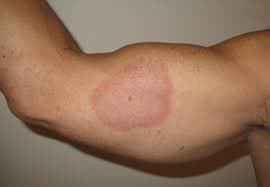
What is granuloma annulare?
Granuloma annulare is a relatively common, harmless inflammatory skin condition that produces smooth, firm, skin-coloured, pink or purple bumps arranged in rings, most often on the backs of the hands, the feet, the ankles or the elbows (DermNet, PCDS, BAD). The typical rings have no scale, which is the most useful clue that separates them from ringworm (DermNet, PCDS). Under the microscope the inflammation surrounds small areas of altered collagen in the deeper layer of the skin, the dermis; pathologists call this pattern a necrobiotic granuloma (DermNet, PCDS).
It affects only the skin (DermNet). It is not a cancer and it is not contagious (AAD, BAD); it is not an infection and it is not caused by an allergy (BAD). In most people it causes no symptoms and clears on its own, although that can take months or years (DermNet, BAD).
Who gets it?
Granuloma annulare is most often seen in children, teenagers and young adults (DermNet, PCDS), and it is rare in babies (PCDS, AAD). The generalised (widespread) form is different: it usually appears in adults with an average age of about 50 (DermNet, PCDS). Women are affected about twice as often as men, for reasons that are not understood (DermNet, BAD, PCDS). It occurs about equally across the world's populations, apart from the rare perforating type, which is most common in Hawaii (AAD).
Causes and triggers
The cause is unknown (BAD, AAD). The best current explanation is a delayed hypersensitivity reaction: the skin's immune cells react to something in the dermis, or to one of many triggers, and inflammation driven by the signalling protein TNF-alpha builds around damaged collagen (DermNet, PCDS). Why this happens in some people and not others is not known (DermNet).
Triggers reported in the medical literature include (DermNet, AAD):
- Injury to the skin. Granuloma annulare often appears at a site of minor trauma; it has developed after a bee sting, a tattoo and even an octopus bite, which suggests the skin is reacting to the injury (AAD).
- Skin infections and infestations of various kinds (DermNet).
- Sun exposure in a minority: some people have the rash only on sun-exposed skin, and a closely related ring-shaped condition, actinic granuloma, arises on sun-damaged necks, faces and hands (DermNet; DermNet actinic granuloma).
Associated conditions. Granuloma annulare has been reported alongside autoimmune thyroid disease, diabetes, abnormal blood fats and, rarely, HIV infection, lymphoma and solid tumours (DermNet). Most people who have it are otherwise healthy, and research is still working out whether the links are real; the association between the widespread form and diabetes remains controversial (BAD, PCDS, AAD). Guidance pages do not treat the localised form as a sign of hidden disease. Doctors consider checking blood sugar if you have symptoms of diabetes (BAD), and in the generalised or persistent form some also check thyroid function and blood fats (AAD, DermNet).
Stress is a common search term alongside this condition. None of the guidance pages from DermNet, the British Association of Dermatologists, the Primary Care Dermatology Society or the American Academy of Dermatology lists stress as a cause or trigger of granuloma annulare.
The types of granuloma annulare
| Type | Who | What it looks like |
|---|---|---|
| Localised (the most common) | Children and young adults mostly | One or a few rings of smooth skin-coloured, pink or purple bumps over the knuckles, backs of the hands, feet, ankles or elbows; rings grow slowly from a few millimetres to 2.5 to 5 cm with a slightly depressed centre, then flatten and fade (DermNet, BAD). |
| Generalised (disseminated) | Adults, average age about 50; develops in fewer than 10% of people with the localised form (BAD) | Many small skin-coloured, pink, purple or yellow-brown bumps over the trunk, arms and legs, often around the armpits and groin. They group into poorly defined rings 10 cm or more across or merge into patches; itch is common. This is the form most associated with diabetes and HIV (DermNet, BAD, PCDS). |
| Subcutaneous | Mainly children | Painless, firm, rubbery lumps 5 mm to several centimetres across, set deep in the skin on the shins, scalp margins, fingertips or hands, sometimes with ordinary rings elsewhere (BAD, PCDS); they look like rheumatoid nodules but are not linked to rheumatoid arthritis (DermNet). |
| Perforating | Mostly older adults, though any age (AAD, DermNet); uncommon except in ethnic Hawaiians and people with HIV | Small yellowish bumps on the hands and fingers with a central crust or dimple that may feel scaly and leak a little clear fluid; often itchy or tender (DermNet, PCDS, AAD); the one type that can leave scars (AAD). |
| Patch | Any age; rare | Flat red, red-brown or violet patches without a raised ring: a single patch, a few, or widespread (AAD). |
| Actinic granuloma | Adults with sun-damaged skin | Rings with a raised, sometimes slightly scaly border and a paler centre on sun-damaged skin of the neck, face, forearms and backs of the hands; regarded by some as a sun-aggravated variant and by others as a separate condition (DermNet; DermNet actinic granuloma; PCDS). |
What granuloma annulare looks like and feels like
The typical lesion starts as a cluster of small firm bumps that join into a ring or an arc. The ring enlarges slowly outwards while the skin inside it returns almost to normal, often slightly sunken (DermNet, PCDS). In the common localised form the surface is smooth with no scale, flaking or crusting, so the skin over it feels like normal skin to the touch (PCDS, DermNet); the rare perforating type, with its central crust, is the exception (DermNet). On white skin the bumps are pink, red or purple; on brown or black skin they are often skin-coloured, brown or violet, and the ring may be easier to feel than to see. The plaques slowly change shape, size and position over months (DermNet).
Most people have no symptoms. The affected skin can be tender when it is knocked, and some people, particularly with the generalised form, have a mild itch (DermNet, BAD). Pain is unusual, and there is no fever or feeling of being unwell.
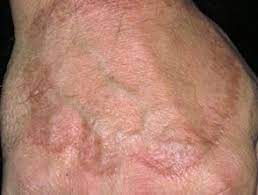
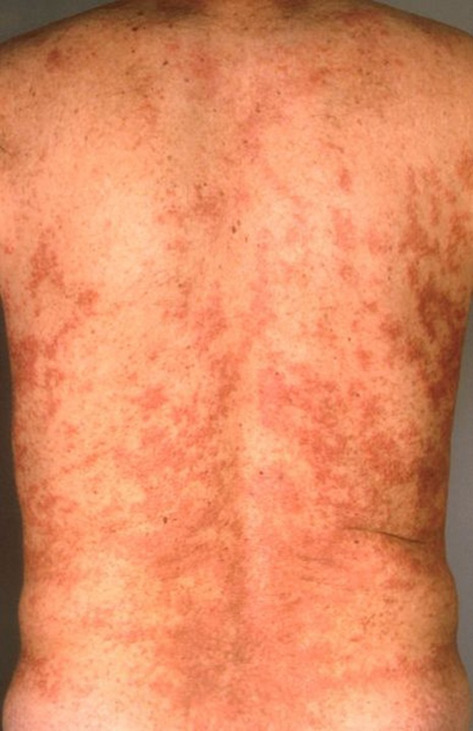
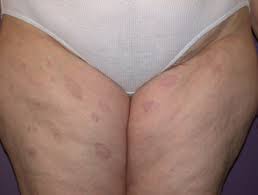
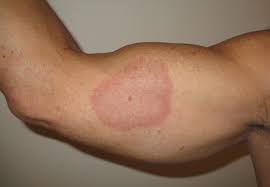
From left: a ring of smooth bumps on the back of a hand; widespread reddish-brown patches across a back, the generalised pattern; ring-shaped plaques on the inner thighs; a single ring with a raised smooth edge on an upper arm.
Granuloma annulare or ringworm?
This is a frequent mix-up, for patients and doctors alike (DermNet, AAD, MedlinePlus). Both make rings. The differences are consistent:
- Scale. Ringworm has a raised, scaly, often bumpy or blistered leading edge; typical granuloma annulare is smooth with no scale (DermNet tinea corporis, PCDS).
- Itch. Ringworm is usually itchy; localised granuloma annulare usually is not (DermNet).
- Spread and contagion. Ringworm is caught from people, pets or shared towels and spreads week by week; granuloma annulare is not infectious and evolves over months (DermNet, NHS ringworm, BAD).
- The test. A scraping of scale from the edge of ringworm shows fungus under the microscope; there is no scale to scrape in granuloma annulare, and the scraping is negative (MedlinePlus, DermNet).
Getting this wrong matters in both directions. Antifungal creams do nothing for granuloma annulare, and a steroid cream applied to unrecognised ringworm damps down the inflammation, so the infection spreads quietly and loses its typical look, a problem called tinea incognito (DermNet tinea incognito). If a supposed ringworm has not responded to four weeks of antifungal cream, ask a doctor to review it (NHS ringworm).
Other conditions that look like granuloma annulare
| Condition | How it differs |
|---|---|
| Ringworm (tinea corporis) | Scaly raised edge, itchy, contagious, positive fungal scraping; see above (DermNet). |
| Erythema annulare centrifugum | Pink rings that enlarge over weeks on the thighs, buttocks and upper arms with a fine trailing scale just inside the advancing edge; often linked to an infection or medicine (DermNet). |
| Erythema migrans of Lyme disease | A single expanding pink or red ring or bullseye around a tick bite, appearing 1 to 4 weeks (up to 3 months) after the bite, sometimes with flu-like symptoms; needs antibiotics (NHS Lyme disease, DermNet). |
| Necrobiosis lipoidica | Shiny yellow-brown patches with a red rim and a thinned centre showing blood vessels, almost always on the shins, often associated with diabetes (DermNet, BAD necrobiosis lipoidica). |
| Annular lichen planus | Shiny, flat-topped, intensely itchy purple bumps with fine white surface lines, forming rings with central clearing, especially in the groin and on the genitals (DermNet lichen planus). |
| Sarcoidosis of the skin | Firm, non-scaly red-brown, purple or yellow-brown bumps and plaques, sometimes ring-shaped, in a multi-organ disease of people aged 30 to 50 that can also cause tender shin lumps (erythema nodosum) and eye inflammation (DermNet sarcoidosis). |
| Discoid eczema and psoriasis | Both are scaly: coin-shaped very itchy weeping plaques in discoid eczema, thick silvery scale in psoriasis; typical granuloma annulare does not scale (DermNet). |
| Insect bites | Intensely itchy bumps on exposed skin that settle within hours to days (DermNet arthropod bites); granuloma annulare can follow a sting but develops over weeks (AAD). |
| Morphoea | Firm, thickened, shiny, ivory-coloured patches with a lilac edge, caused by scarring of the skin; the skin feels hard rather than bumpy (DermNet morphoea). |
| Deep lumps: dermatofibroma, epidermoid cyst, rheumatoid nodules | Dermatofibromas and cysts are usually adult lumps with a tethered dimple or a central pore; in a child, a painless rubbery lump needs a biopsy to tell subcutaneous granuloma annulare from other lumps (DermNet, PCDS). |
How granuloma annulare is diagnosed
A dermatologist usually diagnoses granuloma annulare from its appearance: smooth, non-scaly rings or arcs of firm bumps in the typical sites, in a well person (DermNet, BAD, PCDS). A dermatoscope helps in the perforating type to show the tiny central openings (DermNet).
When the picture is not typical, two tests settle the diagnosis, and blood tests are sometimes added to look for associated conditions (BAD, MedlinePlus, AAD):
- A skin scraping examined in potassium hydroxide excludes ringworm when any scale is present (MedlinePlus).
- A punch biopsy, a 3 to 4 mm sample taken under a local anaesthetic injection in a few minutes, shows the characteristic necrobiotic granuloma and rules out sarcoidosis, necrobiosis lipoidica, lichen planus and other look-alikes (DermNet skin biopsy, BAD, PCDS). It is used mainly for the less common types and for deep lumps (BAD).
- Blood tests. A blood sugar test is done if you have symptoms of diabetes, such as thirst, passing urine often or tiredness (BAD, NHS diabetes). For the widespread or long-lasting forms some dermatologists also check thyroid function and blood fats, and consider an HIV test, because some studies link these conditions with granuloma annulare; not all studies agree, so this is a judgement call rather than a routine (AAD, DermNet).
Tell the dermatologist if you injured the skin where the rings appeared, if you have diabetes, thyroid disease or another diagnosed condition, and which medicines you take (AAD). In iDerma's online consultations, typical localised granuloma annulare can be assessed from sharp daylight photographs taken straight on and from the side, so that the smooth raised edge and the absence of scale are visible; the dermatologist will tell you whether a scraping, a biopsy or blood tests are worth arranging locally.
When to see a doctor
- A ring-shaped rash or ring of bumps anywhere on the skin that has not gone within a few weeks (MedlinePlus).
- A supposed ringworm that has not improved after four weeks of antifungal cream from the pharmacy (NHS ringworm).
- The rings are spreading over the trunk, arms and legs, or are itchy, painful, oozing or crusted (DermNet, AAD).
- A firm lump has appeared under the skin of a child's shin, scalp or hand (DermNet, BAD).
- You have symptoms that could point to diabetes or a thyroid problem alongside a widespread rash: thirst, passing urine often, unexplained weight change or tiredness (BAD, NHS diabetes, NHS underactive thyroid).
- An expanding ring appeared after a tick bite or a walk in long grass or woodland, with or without flu-like symptoms, which could be Lyme disease and needs prompt treatment (NHS Lyme disease).
Treatment: usually unnecessary, sometimes helpful
Most people need no treatment (BAD, AAD, PCDS). In more than half of cases the rings have disappeared within two years without any treatment, usually leaving no trace, and the evidence that treatment changes the course is limited (BAD, PCDS, AAD). Treatment is considered when the rings are very visible and distressing, itchy, widespread or deep (BAD, AAD). No single treatment works reliably for everyone, and the dermatologist weighs the possible side effects against the effect the rash has on your life, remembering that the condition itself is harmless (BAD, AAD).
For a few visible rings
- A strong steroid cream or ointment, sometimes covered with a plaster or film dressing (occlusion) to increase its effect, for a limited course; prolonged use thins the skin (BAD, DermNet, PCDS).
- Steroid injections into the ring itself, used less often, which may also be effective (BAD, AAD, MedlinePlus).
- Cryotherapy, freezing the ring with liquid nitrogen, for very small patches; it can leave a permanent pale scar, so it is used sparingly (BAD, MedlinePlus).
- Steroid-free anti-inflammatory ointments of the prescription class used for eczema (DermNet).
- Laser treatment in selected cases (DermNet, MedlinePlus).
For widespread or stubborn disease
- Phototherapy in a dermatology department. For the generalised form, ultraviolet A combined with a light-sensitising medicine has the best evidence: in one series of 33 patients, half cleared and a further 31% improved; a deeper-penetrating form of UVA (UVA1) has also helped in small series (PCDS, DermNet, AAD).
- Tablets, chosen and monitored by a specialist: medicines of the class used to prevent malaria, which took about three months to show results in one study; tablets that damp down the immune system; a combination of antibiotics taken once a month (DermNet, AAD); and, for resistant cases, injected biologic medicines that block TNF-alpha (DermNet, BAD). None of these clears the condition reliably, all have potential side effects, and they are reserved for people whose widespread rash seriously affects them (DermNet, BAD, PCDS).
What does not help: antifungal creams, which treat ringworm, not granuloma annulare; scrubbing, burning or freezing the rings at home, which risks scarring and pigment change; and diet changes, which no guidance page recommends.
Outlook: how long it lasts and whether it comes back
Individual rings of the localised form tend to clear within a few months to a few years (DermNet); more than half of people are clear within two years (BAD, PCDS), and most within a few years (AAD). The generalised and atypical forms are more persistent and can last for decades (DermNet). Clearing is usually complete, with no scar; only the perforating type can scar (AAD). About 40% of people have a recurrence at some point, often at the same site, whether or not the first episode was treated; a recurrence tends to clear faster than the first episode (BAD, AAD, MedlinePlus).
Living with granuloma annulare
- Sport, swimming, work and school carry on as normal. The condition is not contagious (BAD, AAD), so there is no reason to restrict any activity.
- Skin camouflage creams, highly pigmented products matched to your skin colour, can conceal visible rings; a pharmacist or dermatologist can advise on products (BAD; BAD skin camouflage).
- Sun protection: a minority have a photosensitive pattern, with rings only on sun-exposed skin (DermNet); for them sun protection is sensible.
- Protect the area from knocks if it is tender (DermNet, BAD), and keep the skin moisturised; there is otherwise nothing you need to do to the rings themselves.
- Keep an eye on general health if you have the widespread form: attend any blood tests your doctor suggests and report new thirst, tiredness or weight change (BAD, AAD).
Not sure whether it is granuloma annulare?
A smooth ring of bumps that will not go away, a supposed ringworm that ignores antifungal cream, or a firm painless lump on a child's shin are all good reasons for an online consultation with an iDerma dermatologist. From a few sharp photographs the dermatologist can usually tell granuloma annulare from ringworm, Lyme disease and the other ring-shaped rashes, explain whether any test is needed, and advise whether leaving it alone, a steroid cream, or asking your local doctor about injections or light treatment is the sensible next step.
Sources: DermNet NZ, British Association of Dermatologists (BAD), Primary Care Dermatology Society (PCDS), American Academy of Dermatology (AAD), MedlinePlus and NHS; see the References list below.