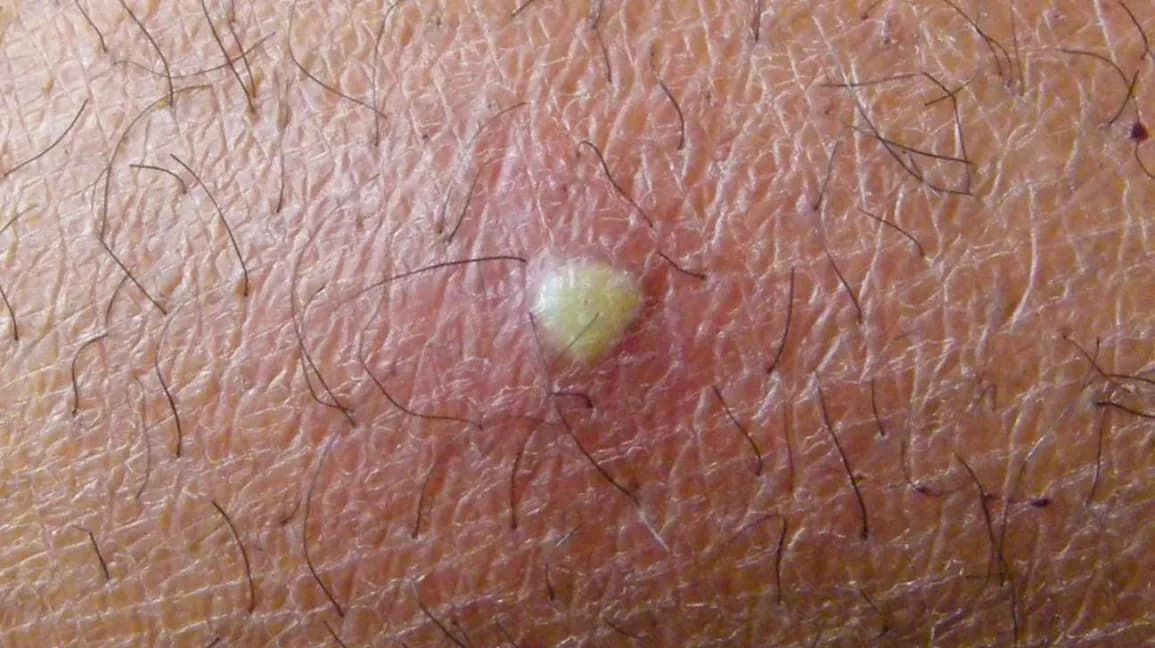
A furuncle, better known as a boil, is a deep bacterial infection of a single hair follicle and the tissue around it. It starts as a tender red lump, fills with pus over a few days and usually bursts or settles on its own within about two weeks. Most boils are caused by Staphylococcus aureus, a bacterium that many healthy people carry on their skin without ever noticing. One boil is rarely dangerous. A boil on the face, a cluster of boils, fever, or boils that keep coming back are the situations that need a doctor.
What is a furuncle (boil)?
Every hair grows out of a follicle, a small pocket in the skin. When bacteria get into the wall of that pocket and the infection spreads deeper than the surface, the body walls it off and fills the space with pus. The result is a furuncle. Dermatologists describe it as a deep form of bacterial folliculitis, and the two often occur together: small superficial pustules around a larger, deeper boil.
Related terms you will see:
- Furuncle and boil. Two names for the same thing: one infected follicle.
- Carbuncle. Several neighbouring follicles infected at once, forming one larger lump with multiple heads. Carbuncles sit deeper, are more painful and are more likely to cause fever, chills and tiredness, and severe ones can leave scars. They are less common and mostly affect middle-aged men.
- Furunculosis. Boils that recur over months, often because the person carries the bacteria in the nose or skin folds.
- Abscess. Any collection of pus in a cavity. A large boil is a type of skin abscess.
A boil is not a cyst. An epidermoid cyst is a non-infected sac under the skin that grows slowly over months and does not hurt unless it becomes inflamed. A boil appears within days and is painful from the start. The two can look alike once a cyst gets infected, which is one reason a persistent lump should be examined.
Causes and risk factors
The usual culprit is Staphylococcus aureus. Other bacteria, and occasionally fungi, can do the same thing, but far less often. Somewhere between 10% and 40% of healthy people carry S. aureus long-term, most often in the nostrils, armpits, groin and the cleft between the buttocks. The bacteria travel from the nose to other sites on the fingertips and under the nails. A tiny nick, a graze, an ingrown hair or clothing rubbing against the skin is enough to push them into a follicle wall, which is a weak point in the skin’s defences.
Most people who get a boil are otherwise healthy and have perfectly good hygiene. Some factors do make boils more likely, or more severe:
- Carrying S. aureus in the nose or skin folds, or living with someone who has boils or another staphylococcal skin infection.
- Diabetes, especially when blood sugar is poorly controlled.
- Obesity. Bacteria thrive in warm, moist skin folds.
- A weakened immune system, whether from an illness such as HIV, from cancer treatment, or from medicines that suppress immunity.
- Skin conditions that break the barrier, such as eczema or acne.
- Iron deficiency, anaemia, malnutrition and smoking.
- Adolescence and male sex. Teenagers and men get boils more often.
- Foreign material in the skin, such as catheters, prosthetic implants or recent surgical wounds.
Symptoms: how a boil develops
A boil evolves in a recognisable sequence. DermNet puts the usual course at about 10 days; most boils have drained within two weeks and the skin has healed within two to three weeks:
- Start. An itchy or tender spot that quickly becomes a firm red lump, warm to the touch and slightly raised.
- Growth. Over a few days the lump grows and hardens. It can be the size of a pea or, less often, as large as a golf ball. The pain increases as pus builds up inside; the skin over it becomes tight and shiny.
- Coming to a head. The centre softens and a white or yellow “head” of pus forms on top. Some boils show a dark dot or plug in the centre: this is the core of the boil at the follicle opening, and it comes away when the boil drains.
- Drainage and healing. The boil bursts and drains pus and blood-stained fluid, or it settles gradually without bursting. Pain eases quickly once it drains. The skin then closes over the following days, often leaving a red or darker mark that fades slowly. Larger boils can scar.
Boils favour hairy, sweaty areas that are exposed to friction: the face, neck, armpits, shoulders, buttocks and thighs, and sometimes the groin. A boil inside the nose or ear canal, or under tight clothing, is especially uncomfortable.
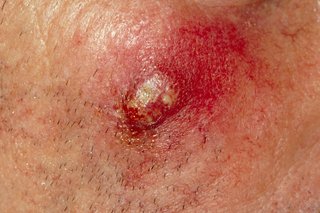
Signs that the infection is no longer confined to the follicle include fever, chills, feeling generally unwell, red streaks spreading out from the lump, or a widening area of hot, swollen, painful skin around it (cellulitis). These need medical attention the same day.
When to see a doctor
Many single boils heal on their own with warm compresses. Make an appointment if:
- the boil has not drained or improved after two weeks of home care;
- it is very large, very painful, or sitting on your spine;
- you get boils repeatedly;
- you have a cluster of boils (a carbuncle).
Seek urgent care (same day) if a boil is on your face, particularly around the nose, upper lip or eyes, if the surrounding skin is hot, swollen and spreading, if you develop fever, chills or shivering, or if you have diabetes or a weakened immune system. Infections in the middle of the face can spread inward along the facial veins, so they are treated more aggressively, and a boil in someone with diabetes or reduced immunity should be assessed early rather than watched.
A dermatologist can confirm that the lump really is a boil, decide whether it needs draining or antibiotics, and look for the reason behind recurrences. An online consultation is well suited to a typical single boil and to follow-up after treatment, while a large, fluctuant boil that needs lancing, or anything with fever, requires an in-person visit.
Diagnosis
A boil is usually diagnosed by looking at it. Tests are reserved for the cases that are not straightforward:
- Swab and culture of the pus, to identify the bacterium and check which antibiotics it responds to. This matters when boils recur, fail to heal, or when an unusual strain such as MRSA or a PVL-toxin-producing S. aureus is suspected. PVL strains in particular cause larger, more painful and more persistent boils that spread within households.
- Nasal and skin-fold swabs in people with recurrent boils, to check for staphylococcal carriage. Household members with boils are asked to follow the same cleansing routine, because the bacteria pass between people who share a home.
- Blood tests when boils keep returning, to look for the conditions linked with recurrence: diabetes, anaemia and iron deficiency.
- Recurrent, scarring boils in the armpits, groin or under the breasts can be a sign of hidradenitis suppurativa rather than simple furunculosis. A dermatologist will consider this if the pattern fits.
Treatment
Treatment depends on the size of the boil, where it is, and whether the infection is spreading.
Home care for a small, uncomplicated boil
- Hold a clean cloth soaked in warm water (or warm salt water) against the boil for 10–20 minutes, three to four times a day. Warmth increases blood flow, speeds the formation of a head and encourages drainage, and eases the pain.
- Do not squeeze, pick, pierce or try to lance a boil yourself. Pressure pushes bacteria deeper and into the surrounding tissue, and can turn a simple boil into cellulitis or a cluster of new boils.
- Once it drains, keep covering it with a sterile dressing until the skin has closed. Change the dressing whenever it is soiled and wash your hands before and after.
- Wash the surrounding skin with an antiseptic or antibacterial wash while the boil is active.
- Simple over-the-counter pain relief can be used for discomfort.
What a doctor may do
- Incision and drainage. If the boil is large and soft (fluctuant) but has not opened, the doctor numbs the skin and makes a small cut to release the pus. Relief is almost immediate. The wound is usually left open to drain and packed or dressed.
- Antibiotics. Not every boil needs them. A course of oral antibiotics is used when the infection is spreading into the surrounding skin, when there is fever, when the boil is on the face, when boils are multiple or recurrent, or when the person has diabetes or a weakened immune system. The choice is guided by the culture result where one is available.
- Decolonisation for recurrent boils. This means clearing S. aureus from its hiding places: an antibacterial body wash for a week and then twice weekly for several weeks, and an antiseptic or antibiotic ointment applied inside the nostrils for 5–7 days. Household members who are found to be carriers may be asked to do the same, because people re-infect each other.
- Treating the underlying cause, such as improving diabetes control or correcting iron deficiency.
With treatment most boils are fully healed in two to three weeks. Serious complications are rare, but the bacteria can occasionally reach the bloodstream and cause sepsis, or seed bone, heart valves or the brain. That is why spreading redness, fever or a facial boil should never be managed at home alone.
Care and prevention
Boils can occur despite excellent hygiene, but the following steps reduce the risk of new boils and of passing the infection on:
- Shower or bathe daily and wash your hands often, especially after touching the boil or its dressing.
- Do not share towels, flannels, razors or bedding. Change your towel daily while you have a boil and wash towels and sheets at least weekly at a high temperature, or immediately if pus has leaked onto them.
- Seal used dressings in a bag before throwing them away.
- Stay out of swimming pools and gyms, and avoid contact sports such as judo or rugby, until the boil has healed.
- Wear loose, breathable clothing over the affected area and avoid activities that cause heavy sweating and friction while it heals.
- If you are overweight and get boils in skin folds, losing weight is one of the measures dermatologists recommend to reduce recurrences.
- Keep diabetes well controlled, and do not smoke.
If a boil keeps coming back in the same place or you have had several in a year, book a consultation rather than treating each one as it appears. Recurrent boils often have an identifiable cause, and clearing bacterial carriage frequently breaks the cycle.