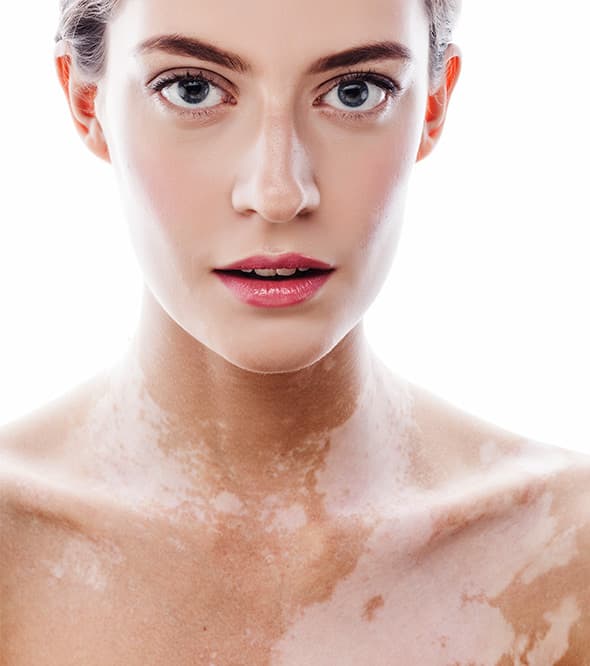
What is vitiligo?
Vitiligo is a long-term skin condition in which patches of skin lose their colour and turn milky white. It happens because the pigment cells of the skin, the melanocytes, are destroyed or stop working, so the affected skin no longer makes melanin (NHS, DermNet). About 1 person in 100 has it worldwide; it affects every skin tone and ethnic group about equally, and it is not contagious (BAD, Cleveland Clinic).
Vitiligo is not an infection and cannot be caught or passed on (NHS, BAD). It is not harmful to your physical health, although the white skin burns very easily in the sun (AAD overview, BAD). It is not caused by diet, smoking or anything you did (BAD, Vitiligo Society).

Types of vitiligo
- Non-segmental vitiligo is the common form, around 9 in 10 cases (NHS). Patches appear on both sides of the body, often symmetrically (both hands, both knees), and tend to spread slowly, with new patches appearing off and on over a lifetime (NHS, AAD overview). Dermatologists describe its extent as localised (a few patches in one or a few places), generalised (scattered patches in several areas) or universal (loss of most skin colour, which is rare) (AAD overview).
- Segmental vitiligo affects one side or one part of the body, such as one arm or one side of the face. It usually starts young, spreads quickly for 6 to 12 months and then stops; after that most people get no new patches (AAD overview, NIAMS). It is the less common type overall but makes up about 3 in 10 cases in children (NHS).
- Mixed vitiligo, with both patterns in the same person, is rare (AAD overview).
- Other patterns include mucosal vitiligo of the lips, mouth or genitals, focal vitiligo (one or a few small patches that have not spread or settled into a recognisable pattern after one to two years) and trichrome vitiligo, where a tan zone sits between the white patch and normal skin (Cleveland Clinic, DermNet).
What causes vitiligo?
Non-segmental vitiligo is an autoimmune condition: the immune system mistakes the body's own pigment cells for a threat and destroys them (NHS, BAD, NIAMS). Segmental vitiligo is thought to be driven by chemicals released from nerve endings in the skin that damage melanocytes (NHS). Research estimates that genes account for around 80% of the risk and environmental factors for the rest (DermNet).
- It often runs in families, but is not simply inherited. More than 20 to 30% of people with vitiligo have an affected first- or second-degree relative, and when one identical twin has vitiligo the other has it in only 23% of cases (DermNet). Many genes are involved, and a trigger is usually needed on top of the genes (AAD causes). Having an affected parent does not mean you will definitely get it, and having vitiligo yourself does not mean your children will (BAD).
- Other autoimmune conditions raise the risk. A personal or family history of thyroid disease, type 1 diabetes, pernicious anaemia, Addison's disease or alopecia areata is more common in people with non-segmental vitiligo (NHS, DermNet, AAD causes).
- Skin injury can start a patch. A cut, graze, burn, severe sunburn, friction from a watch strap or tight clothing, or an inflamed area of psoriasis or dermatitis can be followed by a new patch of vitiligo at that exact site. This is the Koebner phenomenon (NHS, DermNet, BAD).
- Chemicals. Some phenolic compounds, found in certain hair dyes and skin-lightening products and in some workplaces, can trigger vitiligo-like depigmentation, mainly on exposed skin such as the hands and face (AAD causes, DermNet).
- Stress, pregnancy, hormonal changes and vitamin deficiencies are often reported by patients as triggers, but a cause-and-effect link has not been proven (DermNet).
- Rare triggers. A vitiligo-like loss of colour can accompany melanoma or be caused by some modern melanoma drugs, including immunotherapies; vitiligo is also about three times more common after a bone-marrow or stem-cell transplant (DermNet, NHS).
Who gets vitiligo?
- Any age, but mostly young people. Around half of all cases start before the age of 20 and 80% before 30; the average age at onset is 20 to 24 (AAD causes, DermNet). Segmental vitiligo starts even earlier: 41% of cases begin before the age of 10 (DermNet).
- Men and women equally, although women seek help more often (DermNet, Cleveland Clinic).
- All skin tones. The condition is equally common across ethnic groups, but the patches stand out more, and cause more distress, on brown or black skin and on tanned skin (Cleveland Clinic, BAD, DermNet, AAD overview).
Symptoms: what vitiligo looks like
- Milky- or chalk-white patches with a clear edge. A patch often starts pale and gradually turns completely white; the centre may be white with paler skin around it, and a patch over visible blood vessels can look slightly pink (NHS, DermNet). The edges may be smooth or irregular, occasionally red and inflamed, or darker than the surrounding skin (NHS).
- The skin itself is normal. Vitiligo patches are not dry, scaly or raised, and feel the same as the surrounding skin (BAD, NHS).
- Typical sites. The face, especially around the eyes and mouth, the neck, hands and fingertips, feet, armpits, groin, navel and genitals, skin creases, and friction-prone skin such as the elbows and knees (NHS, BAD, DermNet, NIAMS, PMC review). It usually begins on the hands, forearms, feet or face (Cleveland Clinic).
- Hair can turn white. In 10 to 60% of people the hair within a patch loses its colour, on the scalp, eyebrows, eyelashes or beard. White hair in a patch predicts a poorer response to treatment, because the hair follicle is where new pigment cells come from (DermNet, NIAMS).
- Itch is unusual but real. Most patches cause no sensation, but some people notice itching just before a new patch appears or while the condition is active (BAD, AAD symptoms).
- Signs that the condition is active include new patches, patches with blurred rather than sharp borders, tiny confetti-like white spots around a patch, a pink or three-toned (trichrome) edge, and new patches at sites of injury (DermNet, AAD symptoms). Once a patch has settled it turns uniformly white (AAD symptoms).
- Course. Patches typically extend over a few months and then stabilise, sometimes for years, before extending again; cycles of loss and stability can continue indefinitely, and there is no way to predict how much skin will eventually be involved (DermNet, NHS). Some colour can return on its own, usually as speckles around hair roots, but complete spontaneous recovery is rare (BAD, AAD overview).
Vitiligo on white (fair) skin
On very fair skin vitiligo can be almost invisible in winter and appear suddenly in summer, when the surrounding skin tans and the patches do not (DermNet). Light-skinned people also tend to overlook patches on naturally pale sites such as the palms, soles and inside the mouth (DermNet). A patch that is only slightly paler than the rest can be hard to tell apart from pityriasis alba or an old scar. That is when a dermatologist uses a Wood's lamp: a true vitiligo patch glows bright blue-white with a sharp edge (DermNet Wood lamp, AAD treatment). Even when the patches are faint, sun protection matters, because the white skin burns and cannot tan (DermNet, BAD).
Is vitiligo dangerous?
Vitiligo itself does not damage your health, and most people with it are otherwise well (DermNet, AAD overview).
- Sunburn. The white patches have no melanin and burn quickly and painfully; a bad sunburn can also make the vitiligo worse (BAD, Cleveland Clinic, AAD self-care).
- Skin cancer risk is not increased. People with vitiligo do not have a higher risk of skin cancer in the white patches, and studies from several countries have found a lower overall risk of melanoma and non-melanoma skin cancer (AAD overview, DermNet). Sun protection is still essential, because you can still get skin cancer elsewhere (AAD overview).
- Associated autoimmune conditions. The strongest link is with thyroid disease, which affects up to 15% of adults and 5 to 10% of children with vitiligo; type 1 diabetes, pernicious anaemia, Addison's disease, alopecia areata, psoriasis and lichen sclerosus are also more common (DermNet, NHS). Your doctor will ask about tiredness, feeling cold or hot, weight change, thirst and passing urine often, and may check your thyroid with a blood test (NHS, AAD treatment).
- Eyes and ears. Pigment cells also live in the eye and inner ear. Inflammation inside the eye (uveitis, which includes the iris) and some hearing loss have been described; eyesight is usually unaffected and the colour of the iris does not change (NHS, DermNet, Cleveland Clinic). Eye pain, very red eyes, light sensitivity or blurred vision need an urgent same-day appointment, because untreated uveitis can damage sight (NHS uveitis).
White patches: vitiligo or something else?
Not every light patch is vitiligo (AAD causes). An established vitiligo patch is completely white rather than just paler, with a sharp edge, a normal smooth surface and a bright white glow under a Wood's lamp; early or active patches can be paler and less well defined, which is when the lamp helps most (DermNet, DermNet Wood lamp, BAD). The table lists the conditions dermatologists most often need to rule out; use it to prepare questions, not to diagnose yourself.
| Condition | How it differs from vitiligo |
|---|---|
| Pityriasis versicolor (tinea versicolor) | A yeast overgrowth on the chest, back, neck or upper arms. The patches are paler than the surrounding skin rather than pure white (or pink or brown instead), flat, round and finely flaky, and the scale glows yellow-green under a Wood's lamp; the pale colour can linger for months after antifungal treatment (DermNet versicolor, NHS versicolor). |
| Pityriasis alba | A mild form of eczema in children and teenagers aged 3 to 16: 1 to 20 slightly scaly, poorly defined pale patches on the cheeks, chin, neck or upper arms, more visible in summer. The pallor does not enhance under a Wood's lamp and the colour returns within a year or so (DermNet pityriasis alba). |
| Post-inflammatory hypopigmentation | Pale or white marks left behind after atopic eczema, psoriasis, contact dermatitis, a burn, cryotherapy or a laser treatment; the history of a rash or injury at that spot gives it away, and the colour may slowly recover once the cause has settled (DermNet leukoderma, DermNet). |
| Idiopathic guttate hypomelanosis | Many small smooth white spots of 2 to 5 mm on sun-exposed forearms and shins, increasingly common with age and found in about 9 in 10 people in their eighties. The spots stay small, up to 1.5 cm, and slowly increase in number rather than merging into large patches (DermNet IGH). |
| Halo naevus | A mole with a symmetrical white ring 0.5 to 1 cm wide around it, seen in about 1 in 100 white-skinned people, usually healthy children and young adults. The mole fades and the ring usually repigments over years. Halo moles can precede vitiligo, and in adults a full skin check is advised because, rarely, they signal a melanoma elsewhere (DermNet halo naevus). |
| Chemical leukoderma | Linear or splotchy white areas where a phenolic chemical touched the skin, mainly exposed skin such as the hands or face, sometimes with confetti-like spots spreading beyond the contact area; it can look identical to vitiligo and the occupational or product history is the clue (Cleveland Clinic, DermNet leukoderma, DermNet). |
| Lichen sclerosus | Itchy, white, crinkled or thickened patches, most often on the genital skin of women over 50, which can tear, bleed and scar; extragenital plaques look like dry white cigarette paper (NHS lichen sclerosus, DermNet lichen sclerosus). |
| Morphoea | A hard, thickened, shiny ivory-white plaque, often with a purple inflamed border; the skin feels bound down rather than normal (DermNet morphoea). |
| Piebaldism | Present from birth and stable for life: a white forelock in 80 to 90% of cases plus white patches on the forehead, chin, trunk and limbs, often with a darker rim, and the hands and feet are usually spared (DermNet piebaldism, Cleveland Clinic). |
| Naevus anaemicus | A pale patch present since early childhood that is caused by narrowed blood vessels, not missing pigment: it does not redden when rubbed and disappears when the surrounding skin is pressed with a glass slide (DermNet naevus anaemicus). |
| Hypopigmented mycosis fungoides | A rare skin lymphoma that can present as persistent pale, slightly scaly patches; it is one of the conditions a skin biopsy is taken to exclude (DermNet). |
When to see a doctor
Book an appointment with a GP or dermatologist if (NHS, BAD, AAD causes, Cleveland Clinic):
- you notice a new white or pale patch, or an existing patch is growing or new ones are appearing, especially if it is spreading quickly;
- you are not sure whether it is vitiligo (several look-alikes above need different treatment);
- a child develops white patches, or a mole develops a white ring around it;
- you have vitiligo and symptoms that could point to an associated condition: persistent tiredness, feeling the cold or heat more than usual, unexplained weight change, excessive thirst or passing urine often, a sore red tongue, loss of appetite or salt cravings (NHS, NHS hypothyroidism, NHS hyperthyroidism, NHS Addison's, NHS B12);
- you notice a change in your hearing (NHS, AAD causes). Eye pain, very red eyes, light sensitivity, flashes or blurred vision are different: ask for an urgent same-day GP appointment or call the out-of-hours service, and go to an emergency department if you lose vision (NHS uveitis);
- vitiligo is affecting your confidence, mood or daily life. This is a medical reason to seek help, not vanity (BAD, AAD symptoms).
Vitiligo is a medical condition, not only a cosmetic one. Even if you decide not to treat it, a dermatologist can watch for the associated conditions and refer you on if needed (AAD self-care).
How vitiligo is diagnosed
- Examination and history. A doctor can usually diagnose vitiligo by looking at the skin and asking when the patches appeared, whether they followed an injury or sunburn, whether you tan or burn, and whether autoimmune conditions run in the family (NHS, BAD).
- Wood's lamp. In a darkened room, an ultraviolet lamp held 10 to 30 cm from the skin makes vitiligo patches glow bright blue-white with sharp borders, which separates them from the yellow-green glow of pityriasis versicolor and from pale patches that do not enhance at all. It is painless and harmless (DermNet Wood lamp, NHS).
- Dermoscopy and photographs help confirm the diagnosis, judge whether the condition is active and track change over time (DermNet, BAD).
- Blood tests are not needed to diagnose vitiligo itself, but may be arranged to check thyroid function and sometimes vitamin B12, vitamin D or markers of other autoimmune disease, particularly with a positive family history (BAD, DermNet, AAD treatment).
- A skin biopsy is rarely required; it is reserved for atypical cases, for instance to exclude mycosis fungoides or lichen sclerosus (DermNet).
Can vitiligo be treated?
There is no cure. Treatment can slow, and sometimes stop, the spread and bring colour back to many patches, although the results often fade over time (AAD treatment, BAD, NHS). Five things apply to every option (AAD treatment, DermNet):
- It works slowly. Colour returns a little at a time, usually as brown dots around hair follicles that gradually merge; several months are needed before a treatment can be judged (DermNet, BAD).
- Location matters most. The face and neck respond best, then the trunk; the hands, feet, fingertips, lips and any patch with white hair respond poorly (DermNet, AAD treatment). New patches respond better than long-standing ones, and starting early tends to work better (DermNet, AAD overview).
- Combination treatment is usual. A cream plus light treatment generally achieves more than either alone (DermNet, PMC review).
- Results can fade. Within a year of stopping treatment about 40% of people lose some of the regained colour, which is why maintenance treatment is often advised (AAD treatment).
- Not treating is a valid choice. Some people prefer camouflage or no treatment at all; whatever you decide, sun protection stays important (BAD, AAD treatment).
Treatment must be prescribed and monitored by a dermatologist. The options below are described by approach; your doctor will choose the specific product for your age, skin type and the sites involved.
Creams and ointments
- Steroid creams calm the immune attack and are often the first treatment for small areas on the trunk and limbs. They are used for a limited period, typically up to three months, because long-term use thins the skin and can cause stretch marks (NHS, DermNet, AAD treatment).
- Non-steroid immune-calming ointments and creams (the class dermatologists use on eczema) are preferred for the eyelids, face, neck, armpits and groin, because they do not thin the skin and can be used for longer. They work best on the head and neck; a temporary burning feeling where they are applied is the commonest side effect (DermNet, BAD, AAD treatment).
- A newer prescription cream that blocks the immune signalling pathway (a JAK inhibitor) is the first medicine approved specifically to restore colour in non-segmental vitiligo in people aged 12 and over, mainly for the face. In two large trials about 30% of patients regained three-quarters of their facial colour by week 24, and the body responded less; it has been approved for NHS use in the UK, although only through specialist centres. Acne and itch at the application site are the usual side effects, and the cream is judged after 24 weeks (AAD treatment, DermNet, BAD).
- Vitamin D-related creams are used only in combination with other treatment (DermNet).
Light treatment (phototherapy)
Phototherapy with narrowband ultraviolet B is the mainstay for vitiligo that covers a larger area or is spreading. You stand in a light cabinet two or three times a week; a trial of three to four months shows whether colour is returning, and a successful course usually continues for 12 months or longer, and up to two years (DermNet, BAD, DermNet UVB). In a pooled analysis of 35 studies, about 36% of people with generalised vitiligo had a marked response after 12 months of narrowband UVB and 62% after 12 months of PUVA (a tablet or bath that sensitises the skin, followed by UVA light); the face and neck responded best and the hands and feet barely at all (DermNet). Despite PUVA's higher headline figure, narrowband UVB is now preferred because it gives a more even colour match with fewer side effects and a lower long-term skin-cancer risk (PMC review, DermNet UVB, DermNet PUVA).
- The aim is a faint "carnation pink" of the treated skin; burning (red, blistered, peeling or painful skin) must be avoided because it can make the vitiligo worse (DermNet).
- A targeted excimer laser or lamp treats small, stable patches without exposing the rest of the skin, and is usually combined with a cream (BAD, DermNet, PMC review).
- Phototherapy may not suit very fair skin; home phototherapy units are available in some centres (DermNet, BAD).
- Side effects are mostly mild redness and itch; eye protection is worn during sessions, and people who have had very many sessions are offered skin-cancer surveillance (DermNet UVB, AAD treatment).
Tablets for rapidly spreading vitiligo
If new patches are appearing quickly, a dermatologist may prescribe a short course of steroid tablets, often as a "mini-pulse" taken on two consecutive days a week for three to six months, to slow or stop the spread (DermNet, AAD treatment). These are not used long term because of the risks of weight gain, mood change, weakened bones, skin thinning and cataracts (BAD), and they work better combined with light treatment than alone (PMC review).
Surgery
When creams and light have failed, small pieces of normally pigmented skin, or a suspension of pigment cells taken from it, can be transplanted into a patch that has been completely stable for at least 12 months. Most new colour appears within 6 months and can keep developing for up to a year (AAD treatment, BAD). Surgery suits stable and segmental vitiligo best and is not offered when the condition is still active or to people who form keloid scars, because the procedure itself can trigger new patches or scars (DermNet, AAD treatment, Cleveland Clinic).
Camouflage, micropigmentation and depigmentation
- Skin camouflage creams are water-resistant and last a day; self-tanning (fake tan) products give three to five days of colour. Both take practice to match your skin tone; some hospitals run camouflage clinics and the UK charity Changing Faces gives expert advice (BAD, AAD self-care, DermNet camouflage).
- Micropigmentation (medical tattooing) is an option for a patch that has been stable for a long time, but the shade is hard to match, the colour can bleed, the vitiligo can spread beyond it, and the needle injury itself can trigger new patches 10 to 14 days later through the Koebner phenomenon (DermNet, AAD self-care).
- Depigmentation, removing the remaining colour so the whole skin matches, is reserved for people who have already lost most of their pigment and do not want to pursue repigmentation. It takes one to four years, is permanent and is done only under specialist supervision (AAD treatment, BAD).
Vitiligo in children
Many children with vitiligo have an affected relative, and segmental vitiligo, the form that spreads for 6 to 12 months and then stops, is relatively common in childhood (AAD causes, NHS). Most of the treatments above are used in children, with the choice adjusted to age, how fast the patches are spreading and other health conditions; the non-steroid immune-calming creams are suitable for children, light treatment is used when needed, and the JAK-inhibitor cream is licensed from age 12 (AAD treatment, DermNet). Teasing and self-consciousness are common, so emotional support and, where wanted, camouflage are part of the plan (AAD symptoms, DermNet).
Living with vitiligo: sun, skin and mind
- Sun protection whenever the UV index reaches 3, which in the UK and Ireland means most days from March to October and every day in summer (NHS sun safety, DermNet sun protection). Use a sunscreen with SPF 50 and a 4- or 5-star UVA rating on the patches and the skin around them, applied 15 to 30 minutes before going out and reapplied every two hours and after swimming or sweating; add shade between 11am and 3pm, a hat, sunglasses and clothing (BAD, NHS sun safety). Avoiding a tan also keeps the contrast down (AAD self-care).
- No sunbeds and no deliberate tanning. Depigmented skin can only burn, it cannot tan, and tanning the rest of the skin makes the patches stand out (DermNet, AAD self-care).
- Vitamin D. Strict sun avoidance can lower vitamin D; ask your GP whether a vitamin D supplement is advisable (BAD suggests 10 to 25 micrograms a day in that situation).
- Protect the skin from injury. Loose clothing, care with razors and avoiding tattoos over or near patches reduce the chance of new Koebner patches (DermNet, AAD self-care).
- Diet and supplements. No diet, vitamin or herbal product has been shown to treat or prevent vitiligo, and alternative remedies promoted online are not evidence based (DermNet, AAD treatment, BAD).
- Mental health. Low self-esteem, anxiety and low mood are common, especially in adolescents and when the face or hands are involved. Talking therapy, support groups and patient organisations such as The Vitiligo Society help; tell your doctor if vitiligo is getting you down (DermNet, BAD, NHS, AAD symptoms).
Online dermatologist consultation
If white patches have appeared and you want a specialist opinion quickly, you can book an online consultation with an iDerma dermatologist. From clear photographs taken in daylight, including a close-up of a patch edge and a wider shot showing how the patches are distributed, the dermatologist can assess whether the picture looks like vitiligo or one of its look-alikes, explain which type it is likely to be, advise on sun protection and camouflage, and tell you whether you need an in-person visit for a Wood's lamp examination, blood tests or a treatment plan that requires supervision, such as phototherapy. A remote consultation cannot replace those in-person tests, and any prescription treatment still needs monitoring. Eye symptoms, feeling generally unwell, and a new white ring around a mole in an adult need in-person care, not a remote review.
What to do now
- Photograph the patches in daylight today, so that you and your doctor can see later whether they are changing.
- Protect the pale skin from the sun from now on: SPF 50 sunscreen, shade and clothing, and no sunbeds (BAD, AAD self-care).
- Avoid injuring the skin around the patches, and do not try to cover them with a tattoo (AAD self-care).
- Note any tiredness, weight change, thirst or hair loss and mention them at your appointment; ask about a thyroid blood test (NHS, AAD treatment).
- Decide, with your dermatologist, whether you want treatment, camouflage, or simply monitoring. You can change your mind later (BAD, AAD treatment).